
Getting the Whole Family Moving Without Leaving the House
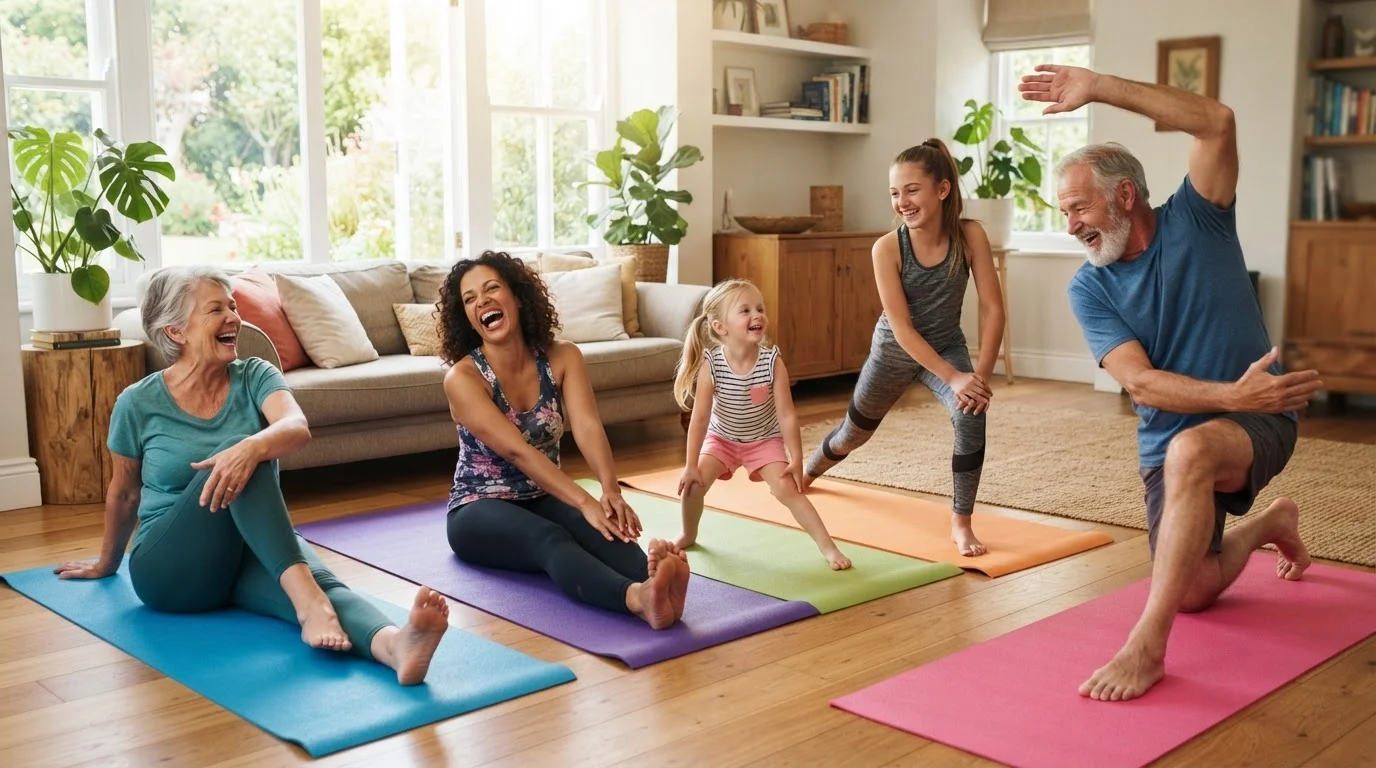
Photo credit: FaqBulletin.com | Information Made Easy
In this article
Practical strategies for building daily movement habits that work for every age group, from toddlers to grandparents—no equipment needed.
Key Takeaways
- Short, frequent movement bursts throughout the day benefit all age groups, from toddlers to older adults.
- No equipment is needed - household furniture and open floor space are sufficient for effective family activity.
- Matching the activity type to each family member's developmental stage improves safety and engagement.
- Consistent daily movement habits at home can meaningfully reduce sedentary time for the whole household.
- Making movement social and playful increases long-term participation across age groups.
Why Home-Based Movement Matters for the Whole Family
For most American households, getting to a gym or organized sports program regularly isn't realistic. Work schedules, childcare, cost, and transportation all create friction that makes structured outside-the-home exercise hard to sustain. Home-based movement removes those barriers entirely - and research supports its effectiveness.
Physical inactivity is one of the most common and consequential health challenges across all age groups. The benefits of regular movement - better cardiovascular health, stronger bones, improved mood, and sharper cognitive function - apply equally whether you're five or seventy-five. The home environment, used intentionally, is a genuinely effective venue for building these habits.
If you're thinking about how to form lasting habits around this, our guide on building a consistent exercise habit from scratch offers a practical framework for getting started. And if your household has a packed schedule, making exercise work around a busy family schedule covers evidence-informed approaches that don't require overhauling your day.
Only 24%
Adults meeting aerobic and muscle-strengthening guidelines
According to the CDC's National Center for Health Statistics, fewer than one in four American adults meet both federal physical activity guidelines.
3-5 min
Effective length of a movement snack break
Research published in sports medicine journals suggests brief activity bouts of as few as three minutes can meaningfully interrupt sedentary time and support metabolic health.
60 min
Daily activity recommended for children ages 6-17
The U.S. Department of Health and Human Services Physical Activity Guidelines for Americans recommends at least one hour of moderate-to-vigorous activity daily for school-age children.
Age-Smart Activity: Matching Movement to Every Family Member
A single activity rarely suits every family member equally - and that's fine. The goal isn't uniformity but participation. Here's how to think about movement across the age spectrum:
- Toddlers (ages 1-3): Unstructured active play is the gold standard. Rolling, crawling obstacle courses made from couch cushions, dancing to music, and simple chasing games all count. Avoid prolonged sitting outside of sleep.
- Preschoolers (ages 3-5): At least three hours of physical activity spread throughout the day is generally recommended. Animal walks (bear crawls, frog jumps), balloon volleys, and imaginative movement games are ideal.
- School-age children (ages 6-17): At least 60 minutes of moderate-to-vigorous activity daily, including muscle-strengthening activities at least three days per week. Yoga, jump rope (even without a rope), bodyweight circuits, and active video games can all contribute.
- Adults: At least 150 minutes of moderate-intensity activity weekly, plus muscle-strengthening on two or more days. Home-based options include bodyweight exercises, yoga, and brisk stair climbing.
- Older adults: Balance and flexibility activities become increasingly important alongside aerobic and strength work. Chair yoga, gentle stretching, and slow controlled movements are well-suited to this group.
Movement Is Not a One-Size-Fits-All Prescription
What counts as appropriate physical activity varies substantially by age, health status, and physical ability. Toddlers, school-age children, adults, and older adults all have different recommended activity types and intensities. The activities described here are general ideas - always adapt them to your family members' individual needs and comfort levels.
Understanding what functional fitness means for everyday families can also help you frame movement choices around real-life capability - not just exercise for its own sake.
Everyday Moments You Can Turn Into Movement
You don't need a dedicated workout block to meaningfully increase your family's daily activity. Many ordinary household moments can become movement opportunities with minimal friction.
- Commercial breaks and loading screens: Use these as cues for two minutes of jumping jacks, squats, or stretching. These brief bursts - sometimes called movement snacks - add up more than most people expect. Our dedicated article on movement snacks and how short bursts add up explains the science behind this approach.
- Music transitions: Turn on a song and move freely until it ends. Even young toddlers engage enthusiastically with this.
- Household chores as team sport: Vacuuming, sweeping, carrying laundry, and wiping down surfaces all involve functional movement. Assign age-appropriate chore segments and make it a group activity.
- Cook-along stretching: While food simmers, family members can do calf raises, countertop push-ups, or simple yoga poses in the kitchen.
Start With Just Ten Minutes
If your household is new to structured movement, ten minutes of intentional activity a day is a completely legitimate starting point. Consistency at a modest level builds the neural and behavioral pathways that make longer sessions feel natural over time. Trying to jump straight to long daily workouts is one of the most common reasons families abandon new routines.
If your home has limited space, fitting movement into small spaces offers specific strategies for apartments and compact homes where floor space is tight.
Structured Family Movement Routines That Actually Stick
While opportunistic movement is valuable, having at least one predictable daily movement window helps the whole household build a genuine habit. The key design principles are simplicity, flexibility, and shared ownership.
A Practical Daily Structure
- Morning activation (5-10 minutes): Light stretching or a few minutes of dancing right after waking sets a positive physical tone. No equipment, no preparation needed.
- Midday reset (5-15 minutes): A brief bodyweight circuit or active game during a lunch break or school transition. Bodyweight squats, wall sits, planks, and bear crawls work for mixed age groups.
- Evening family movement (15-30 minutes): A slightly longer block - yoga, a living room obstacle course, or a family dance party - that everyone participates in together before or after dinner.
Anchor a family movement block to an existing daily ritual - right before dinner prep or immediately after a regular TV show - rather than treating it as an add-on. Habit stacking dramatically improves follow-through.
Behavioral research consistently shows that pairing new habits with established cues reduces the cognitive effort needed to start, making consistency far more likely.
Let children take turns choosing the activity for the day. Ownership over the choice significantly raises their willingness to participate and stick with it.
Autonomy-supportive environments, where kids have some control over decisions, are associated with greater intrinsic motivation and sustained physical activity in younger age groups.
No-Equipment Activity Ideas by Setting
- Living room: Yoga flows, bodyweight circuits, freeze dance, floor-based stretching, animal walks
- Hallway: Shuttle runs, balance walks along a tape line, crab walks
- Stairs: Step-ups, slow controlled stair climbs (adults and older children only, with supervision for young children)
- Kitchen: Countertop push-ups, calf raises, hip circles while waiting
Older Adults and High-Impact Activity
Jumping, running in place, and similar high-impact movements may not be appropriate for older family members, particularly those with joint concerns, osteoporosis, or balance issues. Always encourage grandparents or elderly relatives to check with their healthcare provider before beginning a new movement routine. Chair-based or low-impact adaptations can keep everyone included safely.
Keeping Everyone Motivated Over Time
Motivation naturally fluctuates, especially for children. The households that sustain movement habits over months and years share a few common practices.
Make it social, not performative. Family movement works best when it feels like time together rather than a health obligation. Laughter, silliness, and gentle competition are all good signs - they indicate intrinsic engagement rather than compliance.
Track progress visually. A simple chart on the fridge where each family member marks a daily movement check allows everyone to see the streak building. Visual progress cues are particularly effective for school-age children.
Celebrate consistency, not intensity. Praising effort and showing up - not athletic performance - builds long-term positive associations with movement for children of all ages.
Rotate leadership. Letting different family members lead or invent the day's activity keeps things fresh and builds buy-in across the household.
When the weather allows, complement your indoor routine with outdoor options. Our collection of outdoor activity ideas that double as family bonding time gives you a full menu of ways to extend movement habits beyond the front door.
This Is General Wellness Information
The guidance in this article is educational and intended for generally healthy individuals. It is not a substitute for personalized medical advice. If any family member has a chronic condition, recent injury, or other health concern, please consult a qualified healthcare professional before making changes to their physical activity level.
This article is for general informational and educational purposes only and is not a substitute for professional medical advice. Always consult a qualified healthcare provider before beginning a new physical activity program, particularly for family members with existing health conditions.

Author
Health & Wellness Editorial Team
Health & Wellness Editorial Team is the collective byline for our editorial team and contributor network. Articles published under this byline or an editorial pen name are researched, written, and reviewed according to our editorial standards for clarity, consistency, and independence before publication.
View all articles →