
Crate Training Explained: The Logic Behind the Method
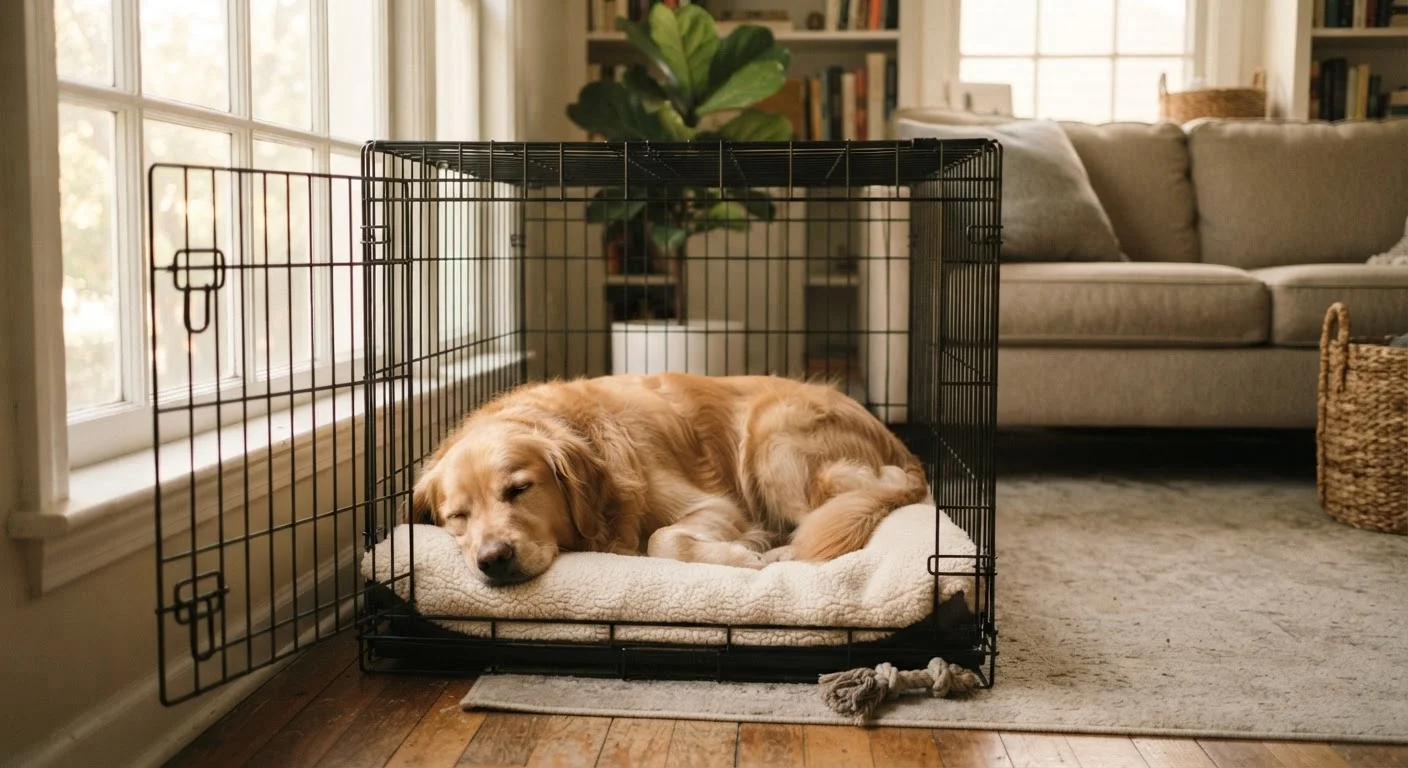
Photo credit: FaqBulletin.com | Information Made Easy
In this article
Crates aren't punishment—they're a management tool grounded in canine behavior. Understand what crate training does and how it works before you start.
Key Takeaways
- Crate training is a management tool rooted in canine denning instincts, not a punishment method.
- A properly sized crate gives dogs a sense of security rather than confinement.
- Crates are most effective when introduced gradually with positive associations.
- Puppies and adult dogs benefit differently, but both can be crate trained successfully.
- The crate should never be used as a place of extended isolation or distress.
Why Crates Aren't What Most People Think
The word "crate" triggers a reflexive discomfort in many new dog owners — images of confinement, restriction, and unhappy animals. That reaction is understandable, but it misreads both the tool and the animal. Dogs are not small humans. They don't interpret enclosed spaces through a human lens of imprisonment. Behavioral science and veterinary professionals broadly recognize that, when introduced properly, a crate aligns with how dogs naturally seek comfort.
The crate is fundamentally a management tool. It prevents unsupervised access to the home during periods when accidents or destructive behavior are likely, and it gives the dog a consistent location it can call its own. Understanding this framing — management, not punishment — is the foundation of using a crate effectively.
Crates Are a Tool, Not a Long-Term Solution
Many owners phase out regular crating as their dog matures and demonstrates reliable household behavior. The crate is most actively useful during puppyhood and the settling-in period after adoption. Whether to continue using one beyond that stage is a personal decision based on the individual dog's needs and preferences.
The Denning Instinct: What's Happening in the Dog's Brain
Dogs descended from den-dwelling ancestors who sought small, enclosed spaces for rest, whelping, and protection. That behavioral tendency didn't disappear with domestication. Many dogs instinctively gravitate toward the space under a desk, behind a couch, or in a tight corner — not because they're afraid, but because enclosed spaces feel regulated and secure.
A crate, when correctly sized and introduced, mimics that denning preference. The dog's nervous system reads it as a predictable environment — low stimulation, protected, associated with rest. This is why crate-trained dogs often voluntarily enter their crates even when the door is left open. The space has become theirs.
This instinctual backdrop matters because it explains why forcing a dog into a crate or using it punitively backfires: it converts a potentially calming space into a source of anxiety. The den instinct is a starting point, not a guarantee — the training process itself determines whether the association becomes positive or negative.
What Crate Training Actually Accomplishes
Crate training serves several overlapping functions that address real, practical challenges in dog ownership:
- Housebreaking: Dogs generally avoid soiling their sleeping area. A properly sized crate exploits this instinct, helping owners predict and reinforce outdoor bathroom behavior — one of the most reliable housebreaking strategies available.
- Preventing destructive behavior: Puppies and newly adopted dogs explore the world with their mouths. Unsupervised access to a home creates real risk — both to property and to the dog, who may ingest something harmful. The crate limits that risk without requiring constant surveillance.
- Building confidence and routine: Predictable structure is foundational to a stable dog. A crate gives the dog a clear "off" signal — a designated time and place for rest — which supports emotional regulation over time.
- Travel and veterinary contexts: Crate-comfortable dogs are significantly less stressed during car travel and veterinary hospitalization, where crating is unavoidable.
These benefits compound. A dog that sleeps well, avoids destructive behavior, and housebreaks reliably is also a dog whose owners are less stressed — and that dynamic matters for the human-animal relationship. As researchers and trainers note, dogs pick up on owner anxiety, making a calmer household a better training environment overall. This connects directly to the broader behavioral factors that shape long-term outcomes in dogs.
Start Small, Build Gradually
The most common crate training mistake is extending sessions too quickly. Begin with just a few minutes of closed-door time and only increase duration when the dog is consistently calm. Rushing the process is the primary reason dogs develop crate anxiety rather than crate comfort.
The Logic of Gradual Introduction
Crate training fails most often because it's rushed. Placing a dog in a crate for extended periods before it's conditioned to accept the space creates distress, not calm. The introduction process should follow a progression:
- Let the dog explore the crate freely with the door open, placing meals or treats just inside the threshold.
- Gradually move food rewards deeper into the crate over several sessions.
- Begin closing the door briefly — seconds at first — while the dog is calm and occupied.
- Incrementally extend closed-door periods, always ending before the dog shows distress.
This is, at its core, a desensitization process. The dog learns, through repeated low-stakes experience, that the crate predicts good things and nothing bad. This aligns with the principles explored in positive reinforcement training: association-building through reward, not compulsion.
The duration of this process varies by dog — some accept the crate within days, others require weeks. Age, prior experience, and individual temperament all play a role. There is no universal timeline, and owners should resist comparing their dog's progress to others.
This article is for general informational and educational purposes only and is not a substitute for guidance from a qualified veterinarian or certified animal behaviorist. If your dog displays significant anxiety or distress during crate training, consult a professional.
Frequently Asked Questions

Author
Pets Editorial Team
Pets Editorial Team is the collective byline for our editorial team and contributor network. Articles published under this byline or an editorial pen name are researched, written, and reviewed according to our editorial standards for clarity, consistency, and independence before publication.
View all articles →