
What "Functional Fitness" Means and Why Everyday Families Should Care
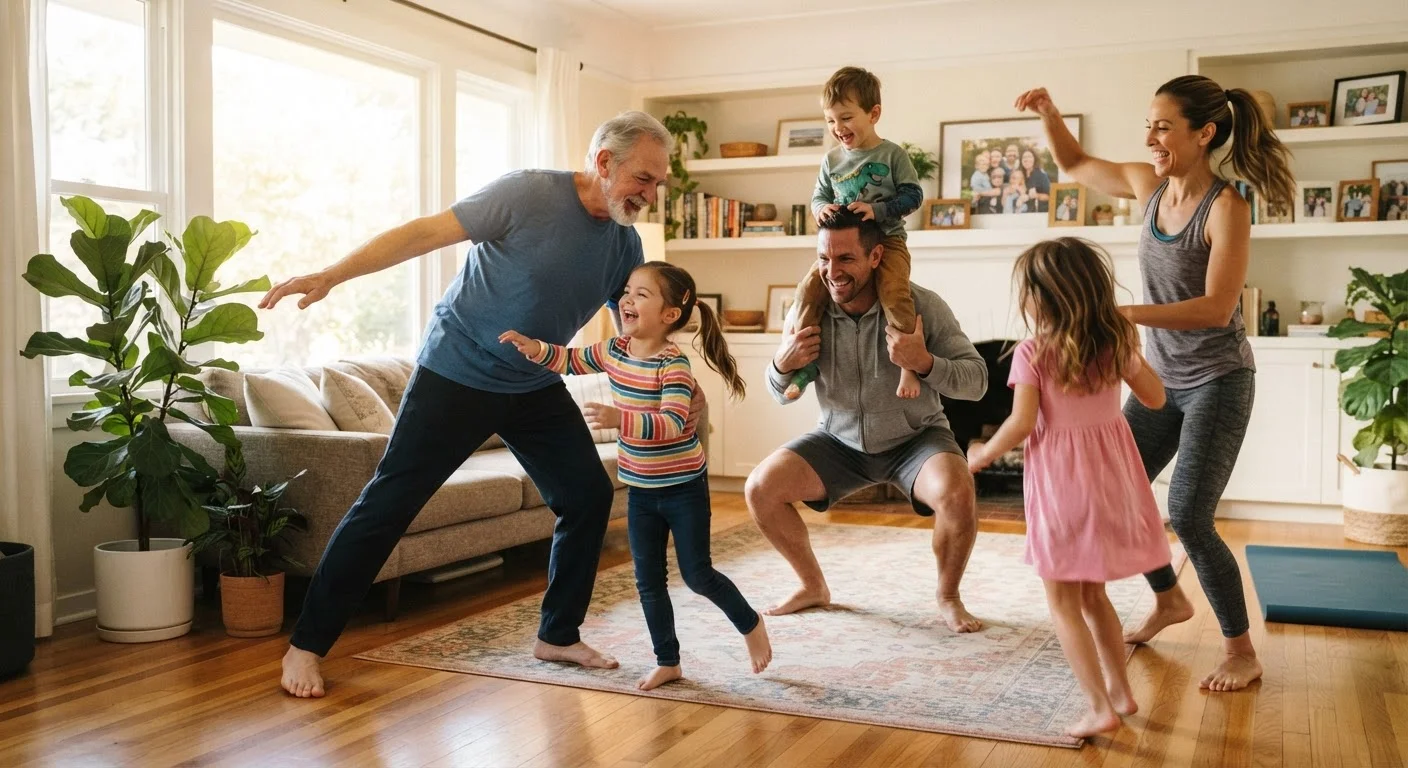
Photo credit: FaqBulletin.com | Information Made Easy
In this article
Functional fitness demystified—what it is, how it differs from conventional exercise, and why it matters for real-life movement.
Key Takeaways
- Functional fitness trains movement patterns used in real life, not just isolated muscles.
- No gym membership or equipment is required to get meaningful functional training.
- Children, adults, and older adults all benefit from functional movement in different ways.
- Improving functional fitness reduces injury risk and supports long-term independence.
- Short, consistent sessions at home can deliver measurable real-world benefit.
How Functional Fitness Differs From Conventional Exercise
Walk into any traditional gym and you'll see rows of machines designed to work one muscle at a time-leg press, chest fly, lat pulldown. These tools have their place, but they're built around isolating muscles in controlled, seated positions that rarely mirror how the body actually moves through a day.
Functional fitness takes the opposite approach. It asks: what does your body need to do in real life? Lifting a laundry basket from the floor, catching a stumbling toddler, reaching overhead to stock a shelf, carrying two bags of groceries from the car-all of these demand coordination between multiple muscle groups, balance, and joint mobility working in concert.
Exercises like squats, lunges, hinges, push-ups, carries, and rotational movements train those exact patterns. Because the body learns movement, not just muscle size, the gains carry over to everyday tasks in ways that isolated machine work often doesn't.
“The best exercise program is the one that prepares you for the demands of your own life-not someone else's athletic goals. Movement that carries over to daily tasks is movement that actually matters.”
— Stuart McGill, Professor Emeritus of Spine Biomechanics, University of Waterloo
Why Families in Particular Stand to Gain
Family life is inherently physical. Parents crouch to pick up small children dozens of times each day. Teenagers haul heavy backpacks. Grandparents need stable balance to play safely with grandkids. Yet many families feel that fitness requires a gym, expensive equipment, or hours of free time-barriers that don't fit real household schedules.
Functional fitness dismantles those barriers. Its foundational movements require nothing but floor space and bodyweight, making it accessible inside any home. More importantly, it frames movement as something woven into daily life rather than something that happens only during a dedicated workout window.
80%
Adults not meeting activity guidelines
The CDC estimates that roughly 4 in 5 American adults do not meet federal guidelines for both aerobic and muscle-strengthening activity.
3M+
Annual ER visits from fall-related injuries
According to the CDC, falls are the leading cause of injury-related ER visits among older adults in the United States, many of which are linked to insufficient strength and balance.
2x
Reduced fall risk with balance and strength training
A systematic review published in the British Journal of Sports Medicine found that exercise programs targeting balance and functional strength can reduce fall rates in older adults by up to 23%.
For families looking to start, our guide on getting the whole family moving without leaving the house offers practical strategies that work across every age group. And if you're concerned about fitting it all in, making exercise work around a busy family schedule provides evidence-informed approaches for full, unpredictable days.
Core Movement Patterns to Understand
Functional fitness is often organized around fundamental movement patterns rather than specific exercises. Understanding these patterns helps families identify opportunities for movement throughout their day:
- Squat: Sitting down and standing up, picking objects off low surfaces. Every chair interaction is a squat.
- Hinge: Bending at the hips to lift from the floor while keeping the spine neutral-essential for safe lifting.
- Push: Pushing open doors, moving furniture, pressing overhead. Horizontal and vertical pushing both matter.
- Pull: Opening heavy doors, carrying groceries, lifting children. Develops back and shoulder resilience.
- Carry: Walking while holding weight in one or both hands strengthens the core and trains real-world load management.
- Rotate: Turning to look behind you, passing objects, getting in and out of a car. Rotational control protects the spine.
Practicing even a few of these patterns consistently-without equipment-builds the strength and mobility that protects against common household injuries.
Start With One Pattern, Not a Full Routine
If functional fitness feels overwhelming to begin, pick just one movement pattern-like a squat-and practice it in small doses throughout the day. Stand up from a chair slowly and with control ten times in a row. Over weeks, this builds genuine strength and body awareness without requiring any formal workout structure.
If you're just beginning to build a routine around these movements, building a consistent exercise habit from scratch is a useful starting point for realistic goal-setting and sustainable scheduling.
Functional Fitness Across Life Stages
One of the most compelling aspects of functional fitness is how it scales across generations within the same household.
Young children develop functional movement naturally through active play-crawling, climbing, throwing, and jumping build the motor patterns that carry forward into adult strength and coordination. Structured play that challenges balance and coordination reinforces this development.
Adults in their working years benefit most from training the movements that their jobs and home responsibilities demand, reducing cumulative strain and lowering injury risk during common tasks like yard work, moving furniture, or carrying children.
Older adults gain perhaps the most critical advantage: improved balance, hip and leg strength, and the confidence to move freely-all of which are directly linked to fall prevention and maintaining independence. Research consistently supports functional exercise as a key component of healthy aging.
Because the same movement patterns apply across all ages-just scaled in intensity-functional fitness is uniquely positioned as something a family can pursue together, rather than in separate, siloed routines. For households with limited space, fitting movement into small spaces offers practical guidance for making it work without a yard or gym.
This article is for general informational and educational purposes only and is not a substitute for professional medical advice. Always consult a qualified healthcare provider before beginning a new exercise program, especially if you have an existing health condition or injury.
Frequently Asked Questions

Author
Health & Wellness Editorial Team
Health & Wellness Editorial Team is the collective byline for our editorial team and contributor network. Articles published under this byline or an editorial pen name are researched, written, and reviewed according to our editorial standards for clarity, consistency, and independence before publication.
View all articles →