
City Break vs. Nature Destination: Matching the Trip to Your Family
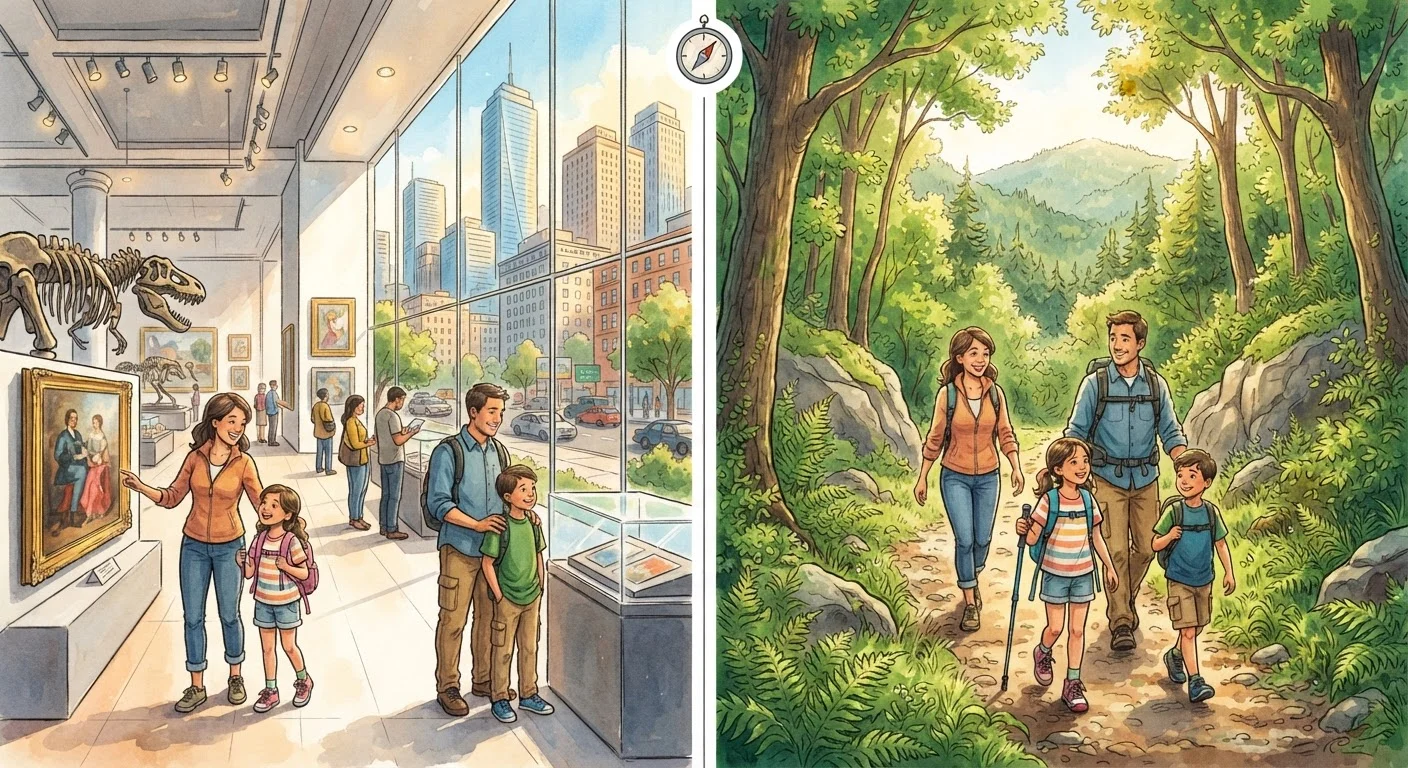
Photo credit: FaqBulletin.com | Information Made Easy
In this article
Museums and transit versus trails and wildlife — how to decide which type of destination will actually work for your family's ages and interests.
Key Takeaways
- Toddlers and teens often have opposite needs — your kids' ages should anchor the destination choice.
- City breaks offer reliable infrastructure, indoor fallbacks, and dense scheduling flexibility.
- Nature destinations reward slower pacing and physical engagement but demand more logistical preparation.
- Neither type is universally superior — family composition, budget, and travel style all matter.
- Mixing both elements (urban base with day-trip nature) is a practical middle-ground strategy.
Why the City vs. Nature Question Actually Matters
Most family trip arguments don't start with a destination — they start with a mismatch. One parent imagines cobblestone streets and museum cafes; the other pictures a tent, a campfire, and no Wi-Fi. Both are valid visions, but without a deliberate framework for choosing, families often default to habit or whoever argues loudest.
The real question isn't which destination type is better. It's which one fits this family, this year. Kids' ages, physical stamina, sensory tolerances, and genuine interests should drive the call — not Pinterest boards. Understanding what makes a destination genuinely family-friendly in practical terms is the right starting point before you even search for flights.
Below, we break down both vacation types honestly — the upsides, the friction points, and the family profiles each suits best.
What City Breaks Actually Deliver for Families
Urban destinations tend to get undersold in family travel conversations, overshadowed by the romance of the outdoors. But cities offer something nature rarely does: density. Within a few city blocks, families can find a natural history museum, a food market, a park, and a subway line — all without a car.
That density becomes invaluable with young children. When a toddler melts down, you're ten minutes from the hotel rather than forty-five minutes down a trail. Rainy-day contingencies are built in. Dietary restrictions are manageable. Medical facilities are accessible.
Cities also tend to reward older, curious kids in a different way than trails do. History, architecture, public art, and cultural immersion are hard to replicate in a wilderness setting. For families with school-age children studying history or science, a well-chosen city can feel like a living classroom.
| Criterion | City Break | Nature Destination |
|---|---|---|
| Best age range | All ages, especially under 6 | 8 and older, ideally |
| Rainy day options | Abundant indoors | Limited, weather-dependent |
| Physical demands | Low to moderate | Moderate to high |
| Logistical complexity | Lower, more predictable | Higher, more variable |
| Accommodation variety | Hotels, rentals widely available | Campgrounds, cabins, some lodges |
| Dietary flexibility | High — diverse options nearby | Low — plan ahead required |
| Sensory environment | Busy, stimulating, loud | Calm, immersive, quieter |
| Bonding through shared challenge | Moderate | High |
The friction points are real, though. Urban travel can be expensive, loud, and overwhelming for children with sensory sensitivities. Crowds at popular museums or transit hubs require patience. Pacing is harder to manage — cities tempt families into overscheduling, which often backfires with kids. The key is choosing one or two anchoring experiences per day and leaving buffer time.
What Nature Destinations Actually Deliver for Families
A well-matched nature trip can be genuinely transformative. Research consistently supports the idea that unstructured time outdoors reduces stress and improves mood in both children and adults — and there's something intangible about watching a child encounter a real waterfall, a bear track, or a star-filled sky for the first time.
Nature destinations also tend to level the playing field across family members. A long hike demands cooperation and shared effort in ways that standing in a museum line rarely does. Outdoor activities that double as family bonding time are especially effective with kids between eight and sixteen, who are often most engaged when given a genuine physical challenge.
90%
Children benefit from outdoor unstructured play
The American Academy of Pediatrics has long emphasized that unstructured outdoor time supports cognitive, physical, and emotional development in children.
3–5 days
Typical sweet spot for family trips
Travel researchers and family therapists generally note that trips in the three-to-five-day range tend to minimize fatigue while maximizing meaningful experience for children.
60%+
US families cite trip conflict over destination type
Surveys from family travel organizations consistently find that disagreement over destination type — not budget — is the most common source of pre-trip family friction.
The logistical bar is higher, though. Gear requirements, variable weather, limited food options, and physical fitness levels all need honest assessment before booking. Families with children under five face real constraints on trail access. And "nature" is a wide umbrella — a lakeside cabin with a beach is a very different proposition than a backcountry national park. For a grounded look at what wilderness travel with kids actually involves, what families actually experience at national parks is worth reading before you pack the hiking boots.
Head-to-Head: Key Practical Differences
Beyond the experience itself, the logistical differences between city and nature travel shape daily life on the road significantly. Accommodation choices alone can define the trip — something worth exploring in depth through a side-by-side look at hotels, vacation rentals, and campgrounds for family stays.
Budget patterns also differ in less obvious ways. City trips front-load costs in accommodation and attraction entry fees but tend to have predictable daily spending. Nature trips may have lower lodging costs but surprise families with gear rental, park permits, or fuel expenses for remote locations.
Weather flexibility is another dividing line. Cities absorb bad weather days gracefully; nature itineraries often can't. A family planning a summer national park trip should have clear backup plans if wildfire smoke, flash floods, or trail closures hit — all real possibilities across much of the US.
For families drawn to the idea of both — urban energy and outdoor access — a city with strong day-trip options (think: Denver, Seattle, or Asheville) can thread the needle. The trip planning hub has practical frameworks for building that kind of flexible itinerary.
Making the Call: A Simple Decision Framework
Strip it back to three questions: What are your kids' ages and stamina levels? What does your family actually enjoy day-to-day, not just in theory? And how much logistical complexity are you prepared to manage?
If your youngest is under five, cities generally win on practicality. If your kids are eight-plus and spend weekends begging to go outside, a nature destination will likely outperform any city's museum lineup. If your group is genuinely split, consider a nature-adjacent city or a structured trip that layers both — two city days followed by two nights at a nearby park, for example.
Also worth asking: what does your family need from this trip emotionally? Rest and reconnection tend to favor slower nature settings. Stimulation and shared discovery often favor cities. Neither answer is wrong. The most important thing is that the trip you plan actually matches the family you're traveling with — not the family you imagine you are on vacation.
For destination-specific comparisons that apply these principles, see national parks vs. beach resorts for a family summer vacation and Florida vs. California family vacation blueprints.

Author
Travel Editorial Team
Travel Editorial Team is the collective byline for our editorial team and contributor network. Articles published under this byline or an editorial pen name are researched, written, and reviewed according to our editorial standards for clarity, consistency, and independence before publication.
View all articles →