
Why Cats Knock Things Off Tables — And What It Actually Means
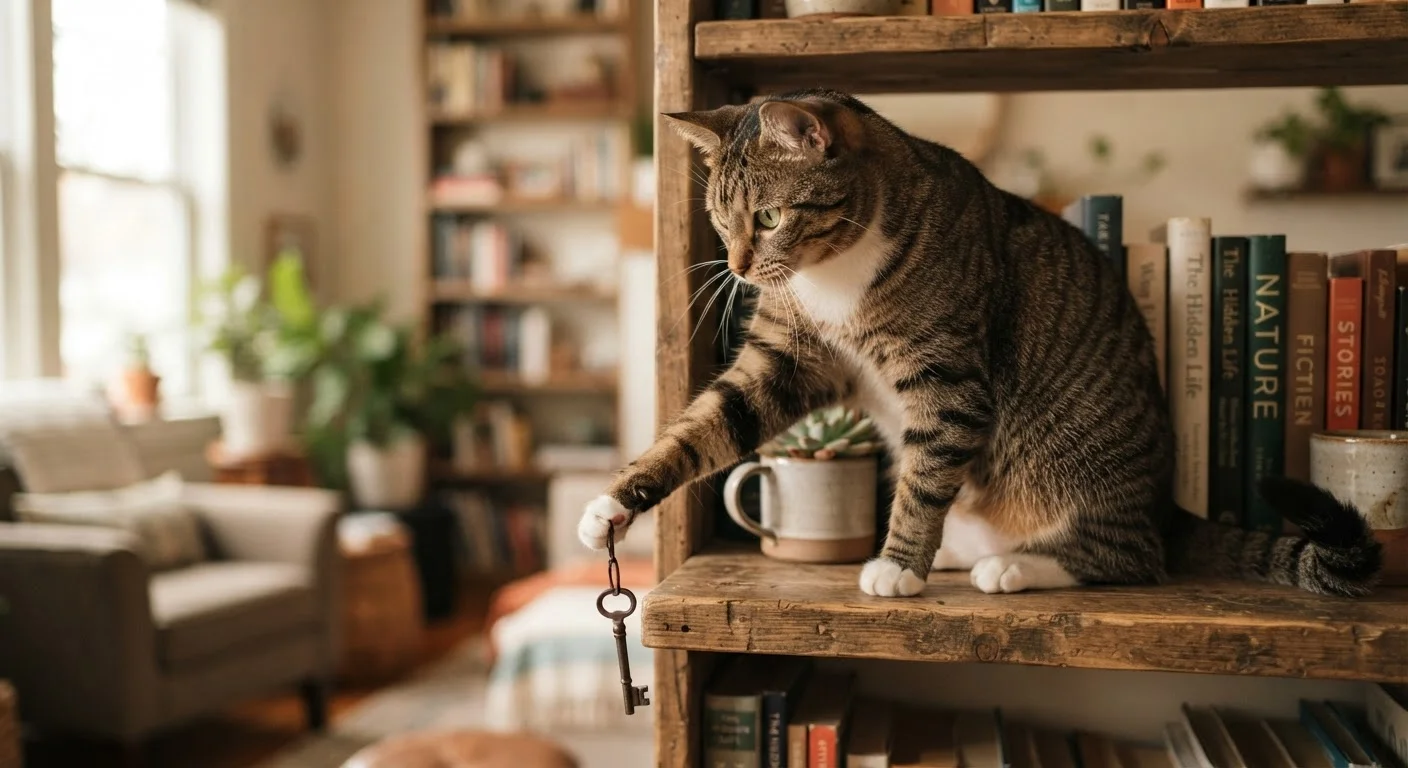
Photo credit: FaqBulletin.com | Information Made Easy
In this article
That shelf-clearing habit isn't random mischief. Learn the behavioral and instinctual reasons cats push objects off surfaces.
Key Takeaways
- Cats knock things off surfaces primarily due to predatory instinct, curiosity, and the need for sensory feedback.
- The behavior is often intensified when cats are under-stimulated or seeking owner attention.
- Object-pushing is normal feline behavior, not spitefulness or defiance.
- Providing adequate enrichment can significantly reduce the frequency of this behavior.
- Cats have sensory receptors in their paw pads that help them gather information about objects before touching them fully.
The Instinct Behind the Swipe
Watch a cat approach an object on a table and you'll notice a deliberate sequence: careful approach, focused gaze, then a calculated paw tap. This mirrors the investigative phase of feline hunting behavior. Before a cat commits to grabbing prey, it probes and bats to assess movement, resistance, and whether the target poses any threat.
Domesticated cats retain this predatory wiring even when the "prey" is a pen or a glass of water. Sensory receptors in a cat's paw pads detect texture, temperature, and vibration — gathering information the eyes alone cannot provide. Pushing an object off an edge adds another layer of feedback: the falling motion and resulting sound mimic the reaction of startled or fleeing prey, creating a satisfying closed loop for the cat's hunting circuitry.
This is why the behavior tends to be deliberate and repeated rather than accidental. The cat is not clumsy — it is engaged.
“Much of what looks like mischief in cats is simply the expression of behaviors that evolved over millions of years. When we understand the function behind an action, we're in a much better position to respond to it appropriately.”
— Dr. John Bradshaw, Anthrozoologist and author of 'Cat Sense'
Attention-Seeking and Environmental Control
Instinct alone doesn't explain all episodes of shelf-clearing. Many cats learn quickly that knocking something over produces an immediate human reaction — a sharp verbal response, a rush to intervene, or even playful engagement. From the cat's perspective, any response is reinforcement. Feline behavior researchers note that cats are skilled at training their owners rather than the reverse, and object-pushing is one tool in that repertoire.
Cats also exert influence over their environment through this behavior. Clearing space on a surface the cat wants to occupy, or disrupting an owner's focused attention on something other than the cat, are both practical outcomes. In multi-cat homes, pushing objects can also serve as a low-stakes way to assert presence. For a deeper look at how territorial dynamics play out between cats, see our guide on managing territory in multi-cat households.
Redirect, Don't Punish
Punishing a cat for knocking things over is ineffective and can erode your relationship with your pet. Instead, remove high-value targets from accessible surfaces and redirect the behavior toward appropriate outlets — a batting toy, a crinkle ball, or an interactive feeder. Rewarding calm, toy-directed play reinforces the alternative.
When Boredom or Under-Stimulation Is the Driver
A cat whose environment provides little novelty will manufacture its own stimulation. Object-pushing is a reliable way to create movement, sound, and human interaction — three things an under-stimulated cat craves. Indoor cats especially, without access to the sensory richness of an outdoor environment, may escalate this behavior when their physical and cognitive needs aren't being met.
Recognizing boredom as a driver is useful because it points directly to a solution: enrichment. Puzzle feeders, rotating toy selections, window perches, and interactive play sessions address the underlying deficit rather than just managing the symptom. Our article on enrichment activities that satisfy a cat's natural hunting instincts offers specific, vet-informed approaches. Structuring your home environment to support feline wellbeing more broadly is covered in our guide to setting up a cat-friendly home.
~60%
Indoor cats showing regular object-manipulation behavior
Behavioral surveys of indoor cat owners consistently report that a majority observe their cats interacting with objects on elevated surfaces, including pushing them off.
16–20 hrs
Average hours cats sleep per day
The significant portion of the day cats spend awake — roughly 4–8 hours — is prime time for exploratory behaviors like object-pushing when enrichment is limited.
What the Behavior Doesn't Mean
A persistent myth holds that cats knock things over out of spite — deliberately acting against their owner's interests as payback for some perceived slight. Behavioral science does not support this interpretation. Cats lack the cognitive framework required for revenge-motivated behavior. Assigning human emotional motives to object-pushing misreads the cat's actual experience and can lead owners to respond in unhelpful ways.
It's equally worth noting that this behavior almost never signals a health problem on its own. However, a sudden onset of compulsive or unusually frantic object interaction — especially in older cats — can occasionally indicate cognitive or neurological changes worth discussing with a veterinarian. For a broader look at how cats signal discomfort in subtle ways, our article on signs of pain in cats is a useful reference. For a fuller list of feline behavioral misconceptions, see common cat health myths vets hear too often.
Understanding the real motivations — instinct, curiosity, attention-seeking, boredom — puts owners in a far better position to respond constructively: removing tempting breakables, providing appropriate outlets, and resisting the urge to react dramatically when it happens.
Frequently Asked Questions

Author
Pets Editorial Team
Pets Editorial Team is the collective byline for our editorial team and contributor network. Articles published under this byline or an editorial pen name are researched, written, and reviewed according to our editorial standards for clarity, consistency, and independence before publication.
View all articles →