
Enrichment Activities That Satisfy a Cat's Natural Hunting Instincts
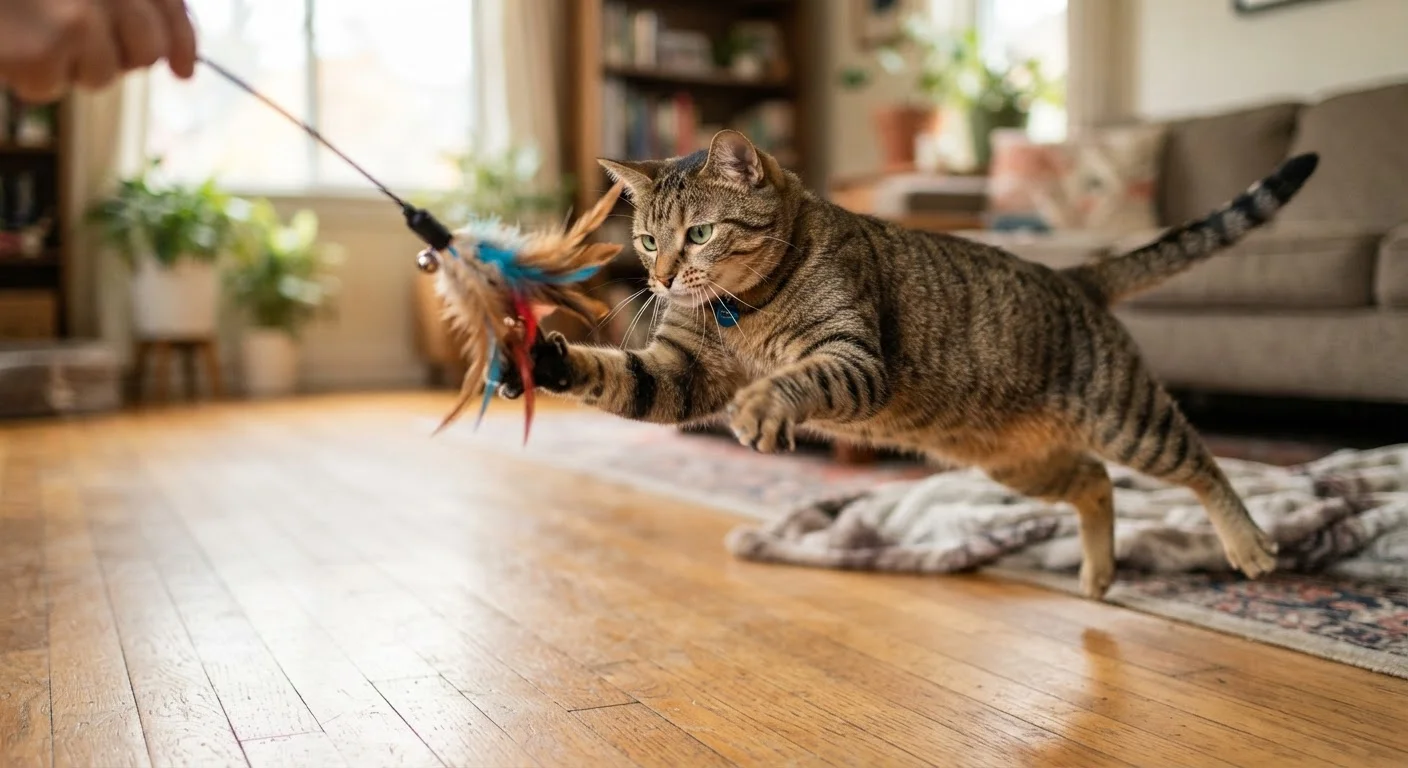
Photo credit: FaqBulletin.com | Information Made Easy
In this article
Puzzle feeders, wand toys, window perches — explore specific enrichment approaches that address feline predatory behavior and prevent boredom.
Key Takeaways
- Cats are hardwired predators — enrichment works best when it mimics the hunt-catch-eat sequence.
- Puzzle feeders and food-dispensing toys merge mental stimulation with a cat's instinct to work for food.
- Wand toys require active owner participation and produce the most behaviorally satisfying play sessions.
- Window perches and bird feeders outside give indoor cats a rich, stimulating visual environment.
- Rotating and varying enrichment items prevents habituation and keeps cats consistently engaged.
- Consistent daily play sessions can reduce stress-related behaviors like over-grooming and aggression.
Why Hunting Instincts Don't Switch Off Indoors
Domestic cats retain the full behavioral repertoire of their wild ancestors. Even a cat that has never left an apartment is neurologically primed to stalk, chase, pounce, and capture. When that drive has no outlet, the result is often redirected aggression, destructive scratching, excessive vocalization, or the flat disengagement that looks like laziness but is closer to chronic boredom.
The good news is that enrichment doesn't require outdoor access to be effective. The key is structuring activities around the natural hunt-catch-eat-groom-sleep cycle that cats are built to repeat several times a day. Mimicking each phase — even partially — produces measurable reductions in stress indicators and problem behaviors. For a broader look at how your cat's environment shapes this behavior, see our guide to setting up a cat-friendly home.
The seven approaches below address different stages of the predatory sequence and can be layered together for maximum effect.
Wand and Feather Toys for Active Chase
Interactive wand toys — those with feathers, ribbons, or crinkle attachments on a flexible rod — are among the most effective tools for engaging the full predatory sequence. They allow you to mimic the erratic, unpredictable movement of real prey: darting under a blanket, hovering and dropping, pausing then sprinting. This unpredictability is critical; a toy that moves in a perfectly straight line quickly loses a cat's interest.
Aim for two 10–15 minute sessions per day. End each session by letting your cat catch and hold the toy for a moment before putting it away — this satisfies the "capture" phase and prevents frustration. Always store wand toys out of reach when unsupervised to avoid tangling hazards.
Unpredictable prey-like movement is what makes wand toys uniquely effective for engaging a cat's chase instinct.
Puzzle Feeders and Food-Dispensing Toys
In the wild, cats expend significant energy locating and capturing each meal. Puzzle feeders replicate this by requiring cats to manipulate, paw, or roll a container to release kibble or treats. This engages problem-solving cognition alongside the predatory drive to "work" for food.
Puzzle feeders range from simple rolling balls to multi-compartment trays with sliders and lifters. Start with lower-difficulty options if your cat is new to them — early frustration can cause a cat to abandon the puzzle entirely. Gradually increasing complexity keeps the challenge rewarding rather than defeating. Using a portion of your cat's regular daily food in puzzles rather than adding extra prevents unintended caloric increases.
Puzzle feeders tap into a cat's hardwired drive to work for food, turning mealtime into meaningful mental exercise.
Window Perches and Outdoor Visual Stimulation
A well-positioned window perch gives an indoor cat access to what animal behaviorists sometimes call "cat TV" — the continuous, unpredictable movement of birds, squirrels, insects, and wind-blown leaves. This engages the visual tracking component of the predatory sequence, even when no physical hunt is possible.
To maximize value, place a bird feeder or birdbath within view of the perch. Motion and variety matter more than proximity. Perches with a wide, padded platform allow a cat to settle in for extended observation sessions. This is a low-effort addition to any home that delivers sustained passive enrichment throughout the day. For broader environmental design considerations, the article on creating a cat-friendly home covers vertical space and sightlines in more depth.
A window perch paired with an outdoor bird feeder delivers hours of passive but behaviorally meaningful stimulation.
Hide-and-Seek Feeding and Scent Trails
Cats in the wild do not find food in a bowl — they locate it by scent, movement, and memory. Hiding small portions of food or treats in different locations around the home activates olfactory hunting, which is a distinct and underutilized channel of enrichment. Place treats inside paper bags, under a folded towel, or on a raised surface the cat must climb to reach.
Scent enrichment can also involve rotating novel, cat-safe smells near resting areas — dried catnip, silver vine, or valerian root each produce different responses in individual cats, and not all cats respond to catnip specifically. Observe your cat's reaction before making any scent a fixture of their environment.
Hiding food engages a cat's olfactory hunting instincts in a way that a food bowl simply cannot replicate.
Vertical Climbing Structures and Stalking Tunnels
Height is a survival advantage for cats — elevation provides both a vantage point for spotting prey and a refuge from perceived threats. Cat trees, wall-mounted shelving, and multi-level condos allow cats to patrol their territory vertically, satisfying the surveillance component of hunting behavior. Structures placed near windows compound the benefit by combining vertical access with visual stimulation.
Collapsible fabric tunnels address a different instinct: the drive to move through enclosed spaces while stalking. Cats that appear uninterested in open-floor toys often engage intensely with tunnel play, particularly when a toy is dragged through the tunnel from the opposite end. These are especially valuable in smaller living spaces where floor space for running is limited.
Vertical structures satisfy a cat's need for elevated surveillance — a core component of feline predatory behavior.
Clicker Training and Trick Sessions
Training is not just for dogs. Cats respond well to positive reinforcement using a clicker or marker word paired with a small food reward. Teaching behaviors like sit, target-touch, or spin engages predatory problem-solving in a structured format and builds a cat's confidence through achievable challenges.
Sessions should be short — three to five minutes at most — to align with a cat's natural attention span during a hunting bout. The real enrichment value lies not in the trick itself but in the mental effort required to understand and repeat a behavior to earn a reward. Cats that engage in regular training sessions often show reduced stress behaviors and increased willingness to interact with their owners.
Short clicker training sessions engage a cat's problem-solving cognition and closely mirror the effort of a real hunt.
Supervised Outdoor Access Through Catios or Leash Walks
For cats whose indoor enrichment still leaves a notable restlessness, controlled outdoor access can address stimulation needs that are difficult to fully replicate inside. A catio — an enclosed outdoor structure attached to a window or door — provides fresh air, real insect movement, and ambient outdoor sound without the safety risks of free roaming. Harness-and-leash walking is another option for cats that tolerate handling and acclimate to a harness gradually.
Neither option is appropriate for every cat, and forcing outdoor exposure on an anxious cat can increase rather than reduce stress. The decision to offer outdoor access involves meaningful trade-offs around health risks, local wildlife, and individual temperament — a topic explored in depth in our indoor vs. outdoor cat guide.
A catio or supervised leash walk gives cats genuine outdoor stimulation while keeping them safe from traffic and predators.
Building a Sustainable Enrichment Routine
No single activity covers every dimension of feline predatory behavior. The most effective approach combines at least two or three of the methods above into a predictable daily rhythm. Many behaviorists suggest scheduling active play sessions — particularly wand toy or chase sessions — before your cat's main meals, since this mirrors the natural hunt-then-eat sequence and can also support healthy weight management. If you're weighing how meal timing interacts with your cat's overall behavior, scheduled versus free feeding has direct implications worth considering.
Rotate Toys to Prevent Habituation
Cats rapidly habituate to toys that remain constantly available — what was exciting on Monday may be completely ignored by Thursday. Keep a small rotation of three to five toys in active use at a time, cycling others in and out every few days. Even familiar toys can regain novelty after a brief absence. This simple practice costs nothing and consistently extends engagement.
Enrichment also scales well to multi-cat homes, though resource competition requires some planning. Independent puzzle stations and separate play sessions can prevent one cat from monopolizing stimulation. Households with more than one cat will find additional strategies in our multi-cat household guide. Rotate toys every few days rather than leaving everything accessible simultaneously — novelty is a powerful motivator, and even a familiar toy reintroduced after a week can reignite intense interest.

Author
Pets Editorial Team
Pets Editorial Team is the collective byline for our editorial team and contributor network. Articles published under this byline or an editorial pen name are researched, written, and reviewed according to our editorial standards for clarity, consistency, and independence before publication.
View all articles →