
Multi-Cat Households: Managing Territory, Feeding, and Social Tension
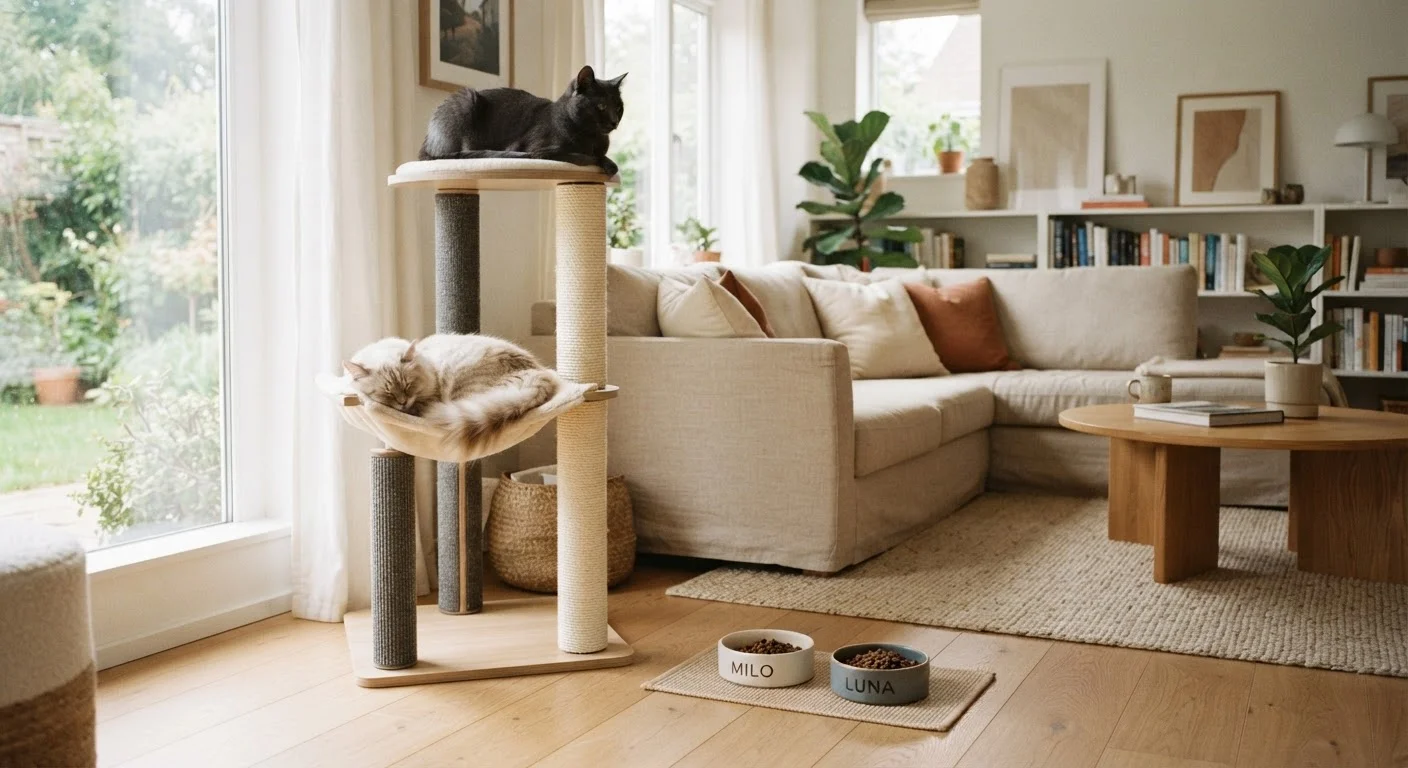
Photo credit: FaqBulletin.com | Information Made Easy
In this article
Two or more cats under one roof require thoughtful resource management. Learn how to reduce conflict and support positive feline relationships.
Key Takeaways
- Cats are naturally solitary hunters; multi-cat tension usually stems from competition over limited resources.
- The N+1 rule for litter boxes, food stations, and resting spots is one of the most effective tension-reducers.
- Separate feeding stations prevent guarding behavior and help you monitor each cat's intake.
- Vertical space — shelves, trees, perches — significantly expands a cat's perceived territory indoors.
- Slow, structured introductions reduce long-term conflict between resident and new cats.
- Persistent aggression, hiding, or appetite changes warrant a veterinary or certified behaviorist consultation.
Why Multi-Cat Tension Happens
Domestic cats evolved as largely solitary hunters, not pack animals. Unlike dogs, they have no strong biological drive to form social hierarchies within a group. When multiple cats share one home, they must negotiate access to the same finite resources — food, litter boxes, resting spots, high perches, and even your attention — without the innate social toolkit that makes group living comfortable.
Tension rarely stems from cats disliking each other in the abstract. It almost always traces back to resource competition or inadequate territory. A cat that controls the staircase, for instance, can effectively deny another cat access to an entire floor. Understanding this dynamic is the starting point for resolving conflict.
Cats also communicate stress differently than dogs. A cat enduring chronic social pressure may not display obvious aggression; instead, it may hide more, groom excessively, or begin eliminating outside the litter box. Recognizing these quieter signals early allows you to intervene before the situation becomes entrenched. For insight into what cats are actually communicating, see our guide to feline body language.
Persistent Aggression Needs Professional Attention
Occasional hissing during an adjustment period is normal, but ongoing physical fights, injuries, or a cat that stops eating or hiding for days are signs that require veterinary or certified feline behaviorist involvement. Do not assume the cats will simply 'work it out' on their own — prolonged stress compromises immune function and quality of life for all animals in the household.
What You'll Need Before You Start
Reducing multi-cat tension is primarily an environmental and behavioral challenge. Before working through the steps below, gather the tools and resources that make the biggest structural difference.
Additional litter boxes
Follow the N+1 rule: one box per cat plus one extra, placed in different locations to prevent guarding.
Separate food and water bowls
Individual stations eliminate resource competition and allow you to monitor each cat's intake accurately.
Cat trees or wall-mounted shelves
Vertical space expands perceived territory and gives subordinate cats safe escape routes from dominant ones.
Puzzle feeders or slow feeders
Slows eating, reduces meal-time competition stress, and provides mental stimulation.
Pheromone diffuser (synthetic feline calming pheromone)
May help reduce ambient stress and tension during introductions or ongoing conflict; consult your vet on use.
Baby gate or door crack barrier
Allows cats to hear and smell each other safely during the early introduction phase without direct access.
What you will need
If your cats span significantly different life stages — for example, a senior cat and a kitten — their needs around feeding, play, and rest differ considerably. Our overview of feline life stages can help you tailor your setup to each cat's current phase.
Step-by-Step: Building a Calmer Multi-Cat Home
Follow these steps in order. Some — like resource auditing and separate feeding — can be implemented immediately. Others, like structured introductions, unfold over days or weeks. Expect a genuine adjustment period; most cats take two to four weeks to begin settling into a new resource arrangement, and introductions between previously unacquainted cats may take several months.
Audit Your Current Resource Distribution
Walk through your home and count litter boxes, feeding stations, resting spots, and high perches. Apply the N+1 rule: for every N cats, you need at least N+1 of each core resource. Two cats need a minimum of three litter boxes. Resources clustered in one room create a bottleneck that dominant cats easily control.
Spread resources across multiple rooms and floors so no single cat can monopolize them. Pay special attention to placing at least one litter box in a low-traffic area where a shy cat can use it without feeling exposed.
Set Up Separate, Spaced-Apart Feeding Stations
Feed each cat in a distinct location, ideally out of visual line-of-sight from the other feeding spots. This prevents one cat from eating quickly and then displacing the other. If your cats eat at different speeds, consider separating them behind a closed door at mealtimes.
For households managing weight differences between cats, separate feeding becomes essential. Review our guide to scheduled versus free feeding to choose the method that best supports individual cats' needs.
Expand Vertical Territory Strategically
Cats assess social hierarchy partly through height. Adding cat trees, wall shelves, or window perches at varying heights gives each cat a position where they feel safe. A subordinate cat that can retreat upward — or to a high spot the dominant cat ignores — experiences significantly less chronic stress.
Place perches near windows for environmental enrichment and near doorways so cats can observe traffic without confrontation. This is a foundational element of a cat-friendly home environment.
Introduce New Cats in Structured Phases
If you are adding a cat to an existing household, confine the new cat to a single room for at least 5–7 days. Swap bedding between the new cat and resident cat so they can acclimate to each other's scent before any visual contact. Progress to door-crack or baby-gate visibility only when both cats seem calm at the barrier.
Gradual introductions are especially important if either cat has no prior experience living with other cats. For households considering their very first cat before expanding, our first-cat preparation guide covers baseline setup that makes multi-cat transitions smoother.
Read and Respond to Body Language Signals
Understanding what your cats are communicating helps you intervene before tension escalates into conflict. Flattened ears, a tucked or puffed tail, dilated pupils, and a low crouched posture signal high stress. A cat that freezes when another enters the room is already in a defensive state.
Learning to read feline body language allows you to redirect cats before a confrontation starts — for example, drawing a tense cat away with a toy rather than physically intervening.
Schedule Individual Daily Interaction Time
Each cat benefits from one-on-one time with you — play, grooming, or quiet companionship. This reduces competition for your attention, which is itself a social resource in multi-cat homes. Rotating individual sessions prevents one cat from monopolizing your presence and reassures shyer cats that they have secure access to you.
Daily interactive play also releases tension and satisfies hunting instincts that, if unmet, can redirect into inter-cat aggression.
Never Force Cats to Share Space Too Quickly
Rushing the introduction process — especially placing a new cat directly into the resident cat's core territory — almost always intensifies conflict and can set back the relationship by weeks or months. Patience during the early phases pays significant dividends in long-term cohabitation.
Enrichment and Ongoing Maintenance
Once your baseline resource structure is in place, consistent enrichment is what sustains a low-tension household long term. Cats that have adequate outlets for predatory behavior — stalking, pouncing, batting — are less likely to redirect that energy onto each other.
Match Enrichment to Each Cat's Personality
Some cats prefer elevated vantage points while others gravitate toward enclosed hiding spots or ground-level tunnels. Offering a variety of enrichment types — vertical perches, puzzle feeders, and solo play options — ensures every cat in the household has outlets that suit their individual style. See our enrichment guide for cats for specific activity ideas.
It's also worth reassessing your setup periodically. As cats age, their mobility and preferences shift. A perch a young cat loved may become inaccessible to the same cat at twelve. Similarly, a cat experiencing a health change may become more reactive or withdrawn — changes in inter-cat dynamics sometimes signal underlying medical issues worth discussing with your veterinarian.
This article is for general informational purposes only and does not constitute veterinary or behavioral advice. If you have concerns about your cat's health or behavior, consult a licensed veterinarian or certified feline behaviorist.

Author
Pets Editorial Team
Pets Editorial Team is the collective byline for our editorial team and contributor network. Articles published under this byline or an editorial pen name are researched, written, and reviewed according to our editorial standards for clarity, consistency, and independence before publication.
View all articles →