
Reading Your Cat's Body Language from Ear to Tail
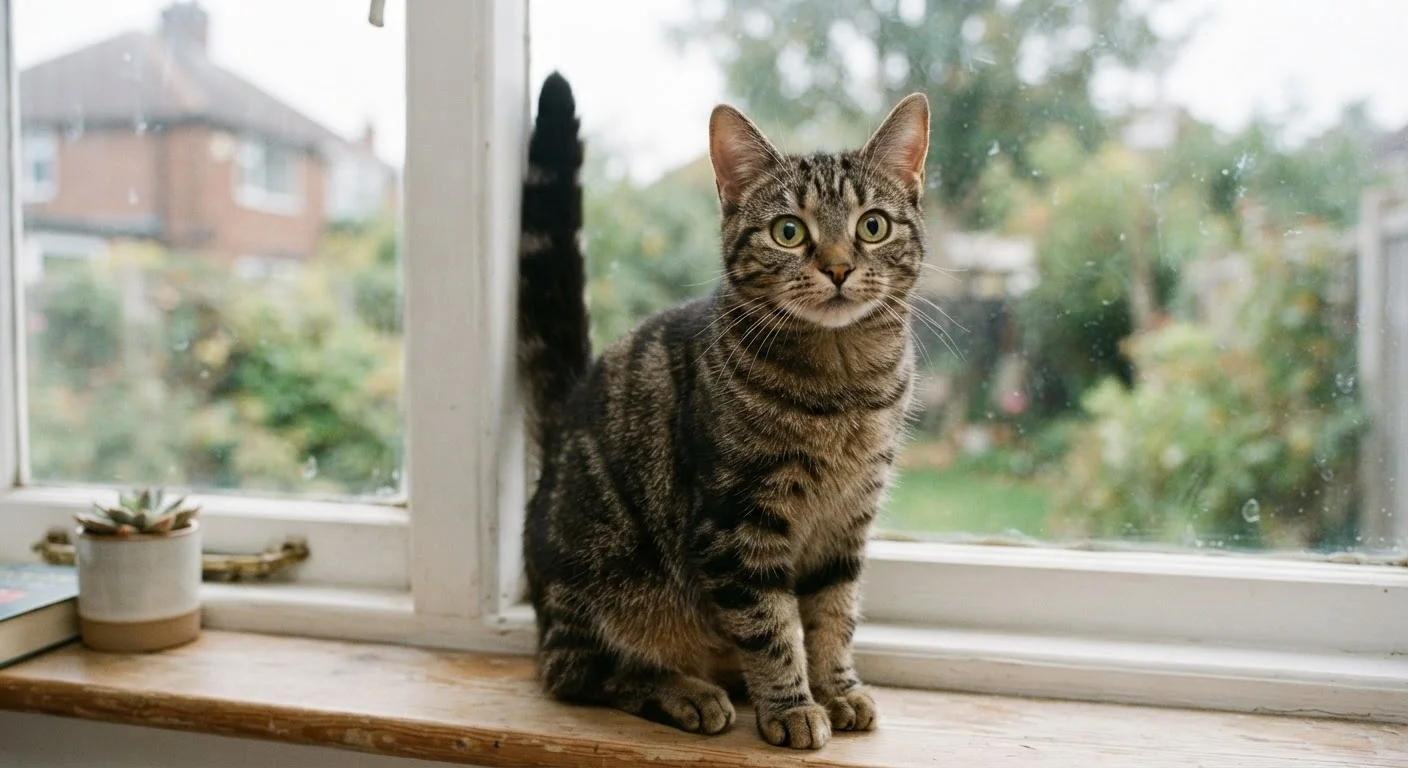
Photo credit: FaqBulletin.com | Information Made Easy
In this article
Ears flat, tail puffed, slow blink — decode what your cat is communicating through posture, facial cues, and movement.
Why Cat Body Language Is Easy to Miss
Cats communicate constantly, but their signals are often subtle enough that even devoted owners misread them. Unlike dogs, whose body language tends toward the broad and expressive, cats work in microgestures — a slight ear rotation, a tail flick, a half-closed eye. Learning to read these cues accurately reduces friction in your relationship with your cat and helps you catch early signs of stress or discomfort before they escalate.
Importantly, no single signal means much in isolation. A twitching tail paired with flattened ears reads very differently from a twitching tail paired with relaxed eyes and upright ears. Always read the full picture. For a deeper look at how masking behaviors can complicate your read on a cat's wellbeing, see our guide on why cats hide signs of pain so well.
| Primary communication channels | Ears, eyes, tail, posture, and vocalizations |
| Ear rotation range | Up to 180 degrees (General feline anatomy literature) |
| Slow blink significance | Affiliative trust signal between cats and humans (University of Sussex, Scientific Reports, 2020) |
| Piloerection trigger | Involuntary adrenaline response — fear or high agitation |
| Tail-up greeting | Indicates friendly, confident approach intent (Applied Animal Behaviour Science) |
| Context rule | No single signal should be read in isolation |
The Ears: Precision Instruments of Mood
A cat's ears can rotate nearly 180 degrees, giving them remarkable expressive range. Here's what the key positions mean:
- Forward and upright: Alert, curious, engaged. Your cat is paying close attention to something interesting.
- Slightly outward ("airplane ears"): Mild anxiety or uncertainty — a warning that your cat is becoming uncomfortable.
- Flat and rotated back: Fear, aggression, or intense stress. Back off and give the cat space.
- One ear forward, one back: Your cat is processing competing stimuli — often a sign of ambivalence or low-grade tension.
Rapid ear-flicking between positions signals overstimulation — common during petting sessions that have gone on too long.
Piloerection
The involuntary raising of fur along the back and tail, caused by adrenaline release during fear or intense arousal. Commonly described as a cat's fur 'puffing up.'
Bunting
The behavior of pressing the forehead or cheeks against a person or object. Cats use bunting to deposit scent from facial glands as a social bonding and territorial marking behavior.
Flehmen response
A brief lip-curling expression a cat makes when investigating an interesting scent, allowing scent molecules to reach the vomeronasal organ. It is a normal sensory behavior, not a sign of distress.
Affiliative signal
A behavior that communicates friendliness or social bonding — such as the slow blink or tail-up greeting — as opposed to threat or appeasement signals.
Overstimulation
A state in which a cat receives more physical or sensory input than it can comfortably process, often resulting in sudden aggression, biting, or rapid ear-flicking during petting.
Eyes and Face: Reading the Blink and the Whisker
Cats use their eyes and facial muscles to convey trust, threat, and everything between.
- Slow blink: One of the clearest affiliative signals in feline communication. A cat that slow-blinks at you is expressing comfort and trust. You can slow-blink back — research from the University of Sussex suggests cats respond positively when humans mirror this behavior.
- Dilated pupils: Can indicate excitement, fear, or low light. Context matters enormously — a cat with wide pupils in bright light is likely emotionally aroused, not simply adjusting to darkness.
- Constricted pupils (narrow slits): Intense focus, confidence, or potential aggression. Combined with a direct, unblinking stare, this is a challenge signal.
- Whiskers forward: Curiosity and engagement. Whiskers pinned flat against the face signal fear or aggression.
- Relaxed, slightly open mouth: Contentment in a calm context. Note that the flehmen response — a brief lip-curl while investigating a scent — is normal and not a sign of distress.
Keep in mind that common cat myths like "purring always means happiness" can lead owners to misread a cat's facial state — a purring cat can simultaneously show stress signals in its face and ears.
The Tail: Your Cat's Emotional Antenna
Tail position is one of the most reliable mood indicators in cats, especially when read alongside posture.
- Tail high and upright: Confidence, friendliness, willingness to interact. A tail held straight up is often a greeting.
- Tail high with a hooked tip: Playful or slightly uncertain — common in cats approaching something new.
- Tail low or tucked: Submission, fear, or illness. A cat that normally carries its tail high but suddenly holds it low warrants observation.
- Puffed tail (piloerection): The cat is frightened or highly agitated — the puffing is an involuntary response to adrenaline, not a choice.
- Slow, wide tail swish: Focused concentration, as during hunting play. A rapid, sharp lash signals irritation or imminent action.
In multi-cat homes, tail signals are particularly important social tools — tails held high during cat-to-cat greetings generally indicate affiliative intent. Our article on managing multi-cat households covers how to use these cues to assess relationships between resident cats.
Posture and Whole-Body Signals
Step back and look at your cat's entire silhouette — posture communicates confidence level and emotional state at a glance.
- Loaf position (legs tucked under body): Relaxed and at ease, but not deeply asleep — the cat is still somewhat alert.
- Rolled onto back, belly exposed: High trust, not necessarily an invitation to touch. Many cats will swipe if their belly is touched in this position — it's a display of comfort, not a request for a rub.
- Arched back with puffed fur: Classic defensive threat posture — the cat is trying to look larger when frightened.
- Crouching low with weight shifted back: Appeasement or preparation to flee. The cat does not feel safe.
- Head butting (bunting) and cheek rubbing: Social bonding and scent-marking. A cat that bunts you is claiming you as part of its social group.
Whether your cat lives indoors, outdoors, or in a hybrid arrangement affects how often it encounters novel stimuli that trigger these stress postures. See our overview of indoor vs. outdoor cat trade-offs for context on how environment shapes feline behavior patterns.
This article is for general informational and educational purposes only. If your cat's behavior changes suddenly or significantly, consult a veterinarian or a board-certified veterinary behaviorist to rule out underlying medical causes.

Author
Pets Editorial Team
Pets Editorial Team is the collective byline for our editorial team and contributor network. Articles published under this byline or an editorial pen name are researched, written, and reviewed according to our editorial standards for clarity, consistency, and independence before publication.
View all articles →