
Active Safety vs. Passive Safety: Two Very Different Lines of Defense
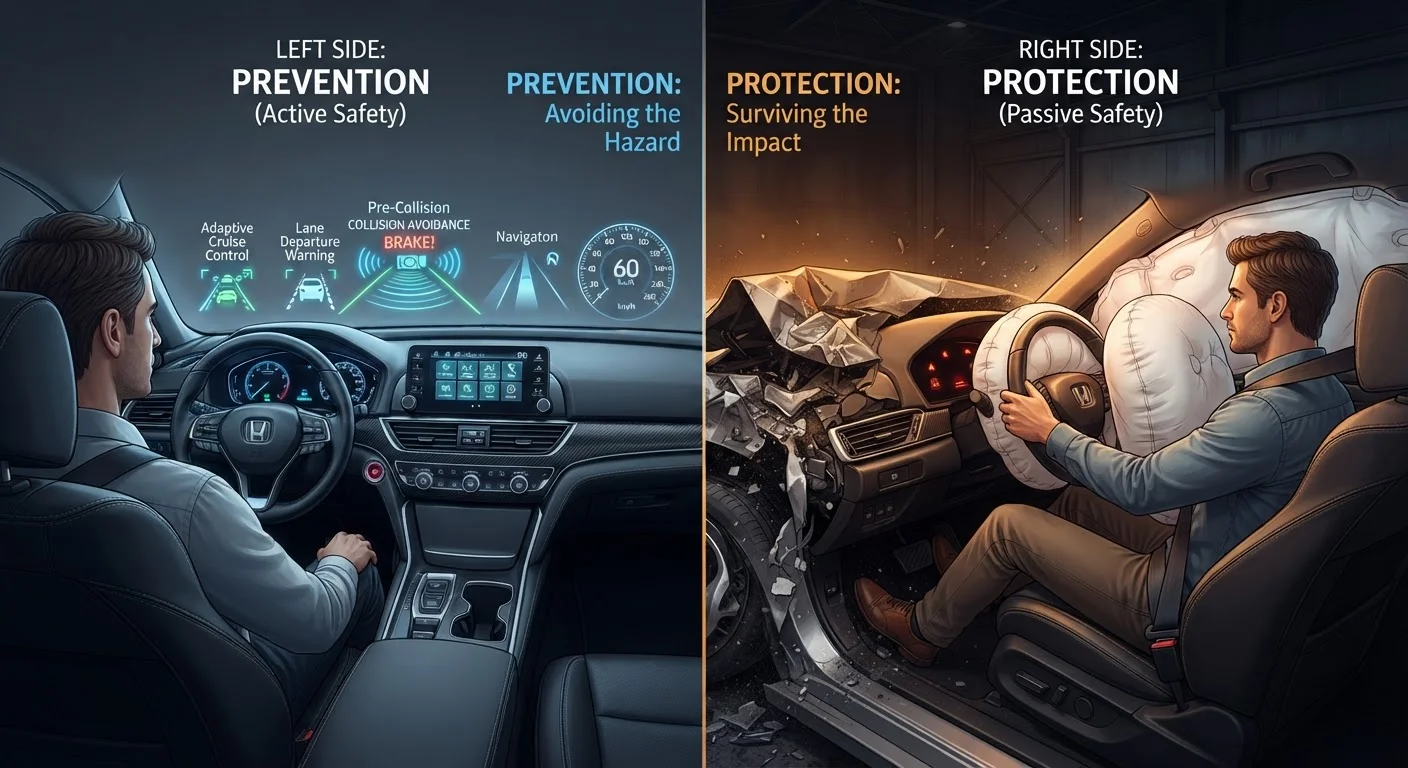
Photo credit: FaqBulletin.com | Information Made Easy
In this article
Learn the difference between systems that prevent crashes and those that protect you during one—and why both matter.
Key Takeaways
- Active safety systems work before a crash - they detect hazards and intervene to prevent collisions.
- Passive safety systems work during and after a crash - they absorb energy and restrain occupants to reduce injury.
- Seatbelts and airbags are the most well-known passive safety features; automatic emergency braking is a leading active example.
- Both systems are complementary - neither alone provides complete protection for vehicle occupants.
- Modern vehicles increasingly blend both categories, and understanding the difference helps you evaluate your car's overall safety profile.
What Active Safety Actually Means
Active safety refers to the technologies and systems engineered to prevent a crash from happening in the first place. These systems continuously monitor the vehicle's environment and the driver's behavior, then intervene - or alert the driver to intervene - before a collision occurs.
Common active safety features include:
- Automatic Emergency Braking (AEB): Detects an imminent forward collision and applies brakes if the driver does not respond in time.
- Lane Departure Warning and Lane-Keeping Assist: Monitors lane markings and alerts the driver - or applies corrective steering - when the vehicle drifts unintentionally.
- Blind-Spot Monitoring: Alerts drivers to vehicles in adjacent lanes that may not be visible in mirrors.
- Electronic Stability Control (ESC): Detects loss of traction and selectively applies brakes to individual wheels to help maintain directional control.
These systems operate in real time, processing sensor data from cameras, radar, and ultrasonic detectors. It is worth noting that active safety features have limits - they can be affected by weather, sensor obstructions, and speed. They assist the driver; they do not replace attentive driving. See our defensive driving principles for habits that complement these technologies.
| Criterion | Active Safety | Passive Safety |
|---|---|---|
| When it operates | Before and during crash prevention | During and immediately after a crash |
| Primary goal | Prevent the collision from occurring | Reduce injury severity in a collision |
| Driver action required | Often none - system intervenes automatically | None - features are structural or auto-deploy |
| Key examples | AEB, ESC, lane-keeping assist, blind-spot monitoring | Seatbelts, airbags, crumple zones, reinforced cabin |
| Technology dependence | High - relies on sensors, cameras, radar | Low - largely mechanical and structural engineering |
| Effectiveness limit | Weather, sensor obstruction, very high speeds | Crash angle, speed severity, occupant position |
| Evaluated by crash testers | Front crash prevention ratings (IIHS, NHTSA) | Crash test star ratings and structural scores |
What Passive Safety Actually Means
Passive safety encompasses the structural and mechanical features that protect vehicle occupants during a crash - once a collision is already happening. These systems require no driver action; they activate automatically or are simply present as engineered protection.
Core passive safety elements include:
- Seatbelts: The single most effective passive safety device. They restrain occupants to prevent ejection and manage forward momentum during a collision. Effectiveness varies by crash type - see our seatbelt effectiveness guide for a detailed breakdown.
- Airbags: Rapidly inflate to cushion occupants from striking hard interior surfaces. They work in conjunction with seatbelts, not as a replacement. Learn more in our airbag explainer.
- Crumple Zones: Sections of the vehicle body engineered to deform in a controlled way during a crash, absorbing kinetic energy before it reaches the passenger compartment.
- Reinforced Passenger Cabin: A rigid structure that maintains a survival space around occupants even as the exterior collapses.
Passive safety has been refined over decades through crash testing by organizations like the National Highway Traffic Safety Administration (NHTSA) and the Insurance Institute for Highway Safety (IIHS). Understanding those ratings is covered in our crash test ratings guide.
~14,955
Lives saved by seatbelts in a single year
According to NHTSA data, seatbelts saved an estimated 14,955 lives in the United States in 2017 alone.
~50%
Reduction in rear-end crash injury with AEB
IIHS research has indicated that automatic emergency braking systems can reduce rear-end crash rates by approximately 50% compared to vehicles without the feature.
~50,000+
Lives saved by airbags since introduction
NHTSA has estimated that frontal airbags have saved more than 50,000 lives in the U.S. since they became standard equipment.
Why Both Systems Belong in the Same Conversation
It would be a mistake to view active and passive safety as competing priorities. They operate in sequence - active systems work to prevent the crash; passive systems take over if prevention fails. A vehicle strong in one area but weak in the other leaves meaningful gaps in occupant protection.
Consider a rear-end collision at highway speed: forward collision warning might alert the driver, AEB might reduce speed before impact - but if that impact still occurs, crumple zones and properly deployed airbags are what determine injury severity. Neither category alone closes the loop.
Active Safety Has Limits - Even in Modern Vehicles
Advanced driver assistance systems are sophisticated, but they are not foolproof. Heavy rain, snow, dirty sensors, or unusual road markings can reduce their effectiveness. Regulatory bodies and automakers consistently note that these systems are designed to assist - not replace - attentive, skilled driving. Always remain engaged behind the wheel even when active safety features are enabled.
Automakers and regulators now evaluate vehicles on both fronts simultaneously. IIHS awards like the Top Safety Pick designation require high scores in both crash test performance (passive) and front crash prevention (active), reflecting the understanding that real-world safety demands both layers of defense.
For drivers evaluating a vehicle's safety profile, the most informed approach is to examine crash test ratings alongside the active driver assistance features included - or available as options. Our ADAS features comparison can help you assess what each system actually contributes.

Author
Automotive Editorial Team
Automotive Editorial Team is the collective byline for our editorial team and contributor network. Articles published under this byline or an editorial pen name are researched, written, and reviewed according to our editorial standards for clarity, consistency, and independence before publication.
View all articles →