
Car Safety Ratings Explained: What NHTSA and IIHS Scores Actually Tell You
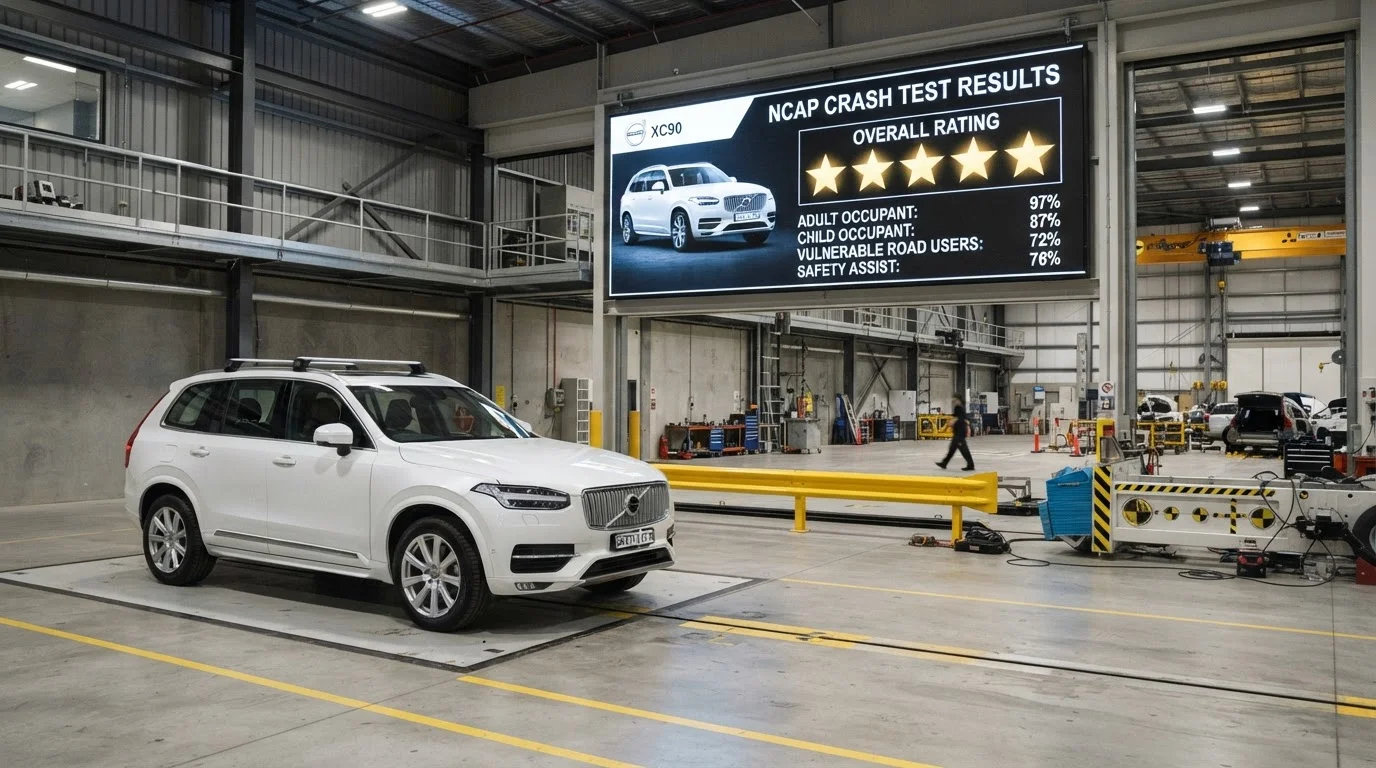
Photo credit: FaqBulletin.com | Information Made Easy
In this article
Decode crash test ratings from NHTSA and IIHS so you understand what those stars and awards really mean for your family's safety.
Key Takeaways
- NHTSA and IIHS are independent programs with different test methods - a vehicle should ideally perform well in both.
- Five stars from NHTSA does not automatically mean a vehicle earns a Top Safety Pick from IIHS.
- IIHS evaluates headlights and front crash prevention systems in addition to crashworthiness.
- Ratings apply to specific model years and trim levels - the same nameplate can score differently across configurations.
- Active safety technologies like automatic emergency braking now factor into overall safety evaluations.
- Always verify ratings using the official NHTSA and IIHS websites before making a vehicle decision.
Two Programs, Two Very Different Tests
When you see crash test scores cited in a vehicle review or on a dealer window sticker, those numbers almost always come from one of two sources: the National Highway Traffic Safety Administration (NHTSA) or the Insurance Institute for Highway Safety (IIHS). Understanding the difference between them is the first step to reading those scores correctly.
NHTSA is a federal agency operating under the U.S. Department of Transportation. It conducts its own crash tests and publishes results under the New Car Assessment Program (NCAP). Vehicles receive one to five stars in each of three areas: frontal crash, side crash, and rollover resistance. An overall star rating is also calculated, but it can mask significant variation between individual categories.
IIHS, by contrast, is an independent nonprofit organization supported by auto insurers. Rather than stars, it assigns ratings of Good, Acceptable, Marginal, or Poor across several distinct test types. These currently include small overlap front, moderate overlap front, side, roof strength, and head restraint evaluations, among others. IIHS also separately evaluates headlight performance and front crash prevention - areas that NHTSA handles differently.
Because the programs use different crash configurations and scoring systems, a single vehicle can earn top honors from one organization while performing only adequately - or worse - in the other. Families who rely on just one rating may be getting an incomplete picture. For a broader look at how crash protection fits into the full safety picture, see our article on active vs. passive safety.
What the Scores Actually Measure
Both programs test crashworthiness - how well a vehicle protects occupants during a collision - but they approach it differently and cover different crash geometries.
NHTSA's frontal crash test sends a vehicle into a full-width rigid barrier at 35 mph. The side-impact test uses both a moving barrier (simulating another vehicle) and a pole test. Rollover resistance is not a crash test at all; it uses a formula based on the vehicle's center of gravity to estimate the probability of rolling over in a single-vehicle crash.
IIHS introduced the small overlap front test - where only 25% of the vehicle's front corner strikes a rigid barrier - because real-world data showed a significant share of serious frontal crashes involved partial overlap that traditional tests didn't replicate well. This test has exposed structural weaknesses in vehicles that previously earned high NHTSA scores.
25%
Overlap used in IIHS small overlap front test
IIHS introduced this test after crash data showed a significant portion of serious frontal collisions involved only partial front-end contact - a scenario traditional full-width tests did not capture.
5 Stars
Highest NHTSA rating per crash category
NHTSA's five-star system scores frontal, side, and rollover categories separately; the overall rating is a weighted calculation and may not reflect performance in any single category.
4
IIHS grade levels for crashworthiness
IIHS uses Good, Acceptable, Marginal, and Poor - only a Good or Acceptable rating in required tests qualifies a vehicle for Top Safety Pick consideration, depending on the criteria year.
Beyond crashworthiness, IIHS rates crash avoidance and mitigation technology. Vehicles with front crash prevention systems - including automatic emergency braking (AEB) - are evaluated separately, and those ratings now influence whether a vehicle earns Top Safety Pick or Top Safety Pick+ status. This means a structurally strong vehicle without adequate AEB may still fall short of IIHS's top designation.
Headlights are another area unique to IIHS evaluations. Poor headlights reduce a driver's ability to see and react, which IIHS considers a meaningful crash-risk factor. A vehicle can be structurally excellent and still receive a lower designation because its standard headlights underperform at illuminating curves or produce excessive glare.
How to Read the Ratings Without Being Misled
One of the most common misreads is treating the overall NHTSA star rating as a single definitive verdict. An overall four-star rating might reflect five stars in frontal protection and only three stars in rollover resistance. For a tall SUV carrying children, that rollover number deserves close attention.
Check Both Programs Before Deciding
Look up the vehicle's scores on both safercar.gov (NHTSA) and iihs.org (IIHS) using the specific model year and trim you're considering. Review individual sub-ratings rather than stopping at the overall score or award designation. Discrepancies between the two programs often reveal the most useful information.
Similarly, IIHS's Top Safety Pick+ designation is recalibrated periodically. A vehicle that earned the award in a prior model year may not qualify under updated criteria - particularly if IIHS has tightened its headlight or front crash prevention standards. Always verify that the rating applies to the exact model year and trim you are researching.
Trim level matters more than many buyers realize. IIHS often tests a specific configuration, and base-level trims with lower-quality headlights or without standard AEB may not qualify for the same designation as a higher trim. Confirm which configuration was actually tested before assuming the result applies to your intended purchase.
It's also worth recognizing what these ratings don't cover. They do not evaluate real-world driving behavior, long-term mechanical reliability, or the interaction between occupant size and restraint system design across every body type. For perspective on how safety systems complement each other, our overview of seatbelt effectiveness across crash scenarios provides useful context.
Parents researching vehicles for new or teen drivers should apply the same scrutiny to ratings. Motor vehicle crashes remain a serious risk for young drivers, and selecting a structurally sound vehicle with proven crash avoidance technology is one of many factors worth considering. Our guide on teen driver safety covers additional risk factors relevant to that conversation.
For the most accurate and current information, consult the official NHTSA database at safercar.gov and the IIHS ratings at iihs.org. These are the primary sources - ratings cited elsewhere may be outdated or based on prior model years.
Frequently Asked Questions

Author
Automotive Editorial Team
Automotive Editorial Team is the collective byline for our editorial team and contributor network. Articles published under this byline or an editorial pen name are researched, written, and reviewed according to our editorial standards for clarity, consistency, and independence before publication.
View all articles →