
Airport Security Myths That Keep Slowing Travelers Down
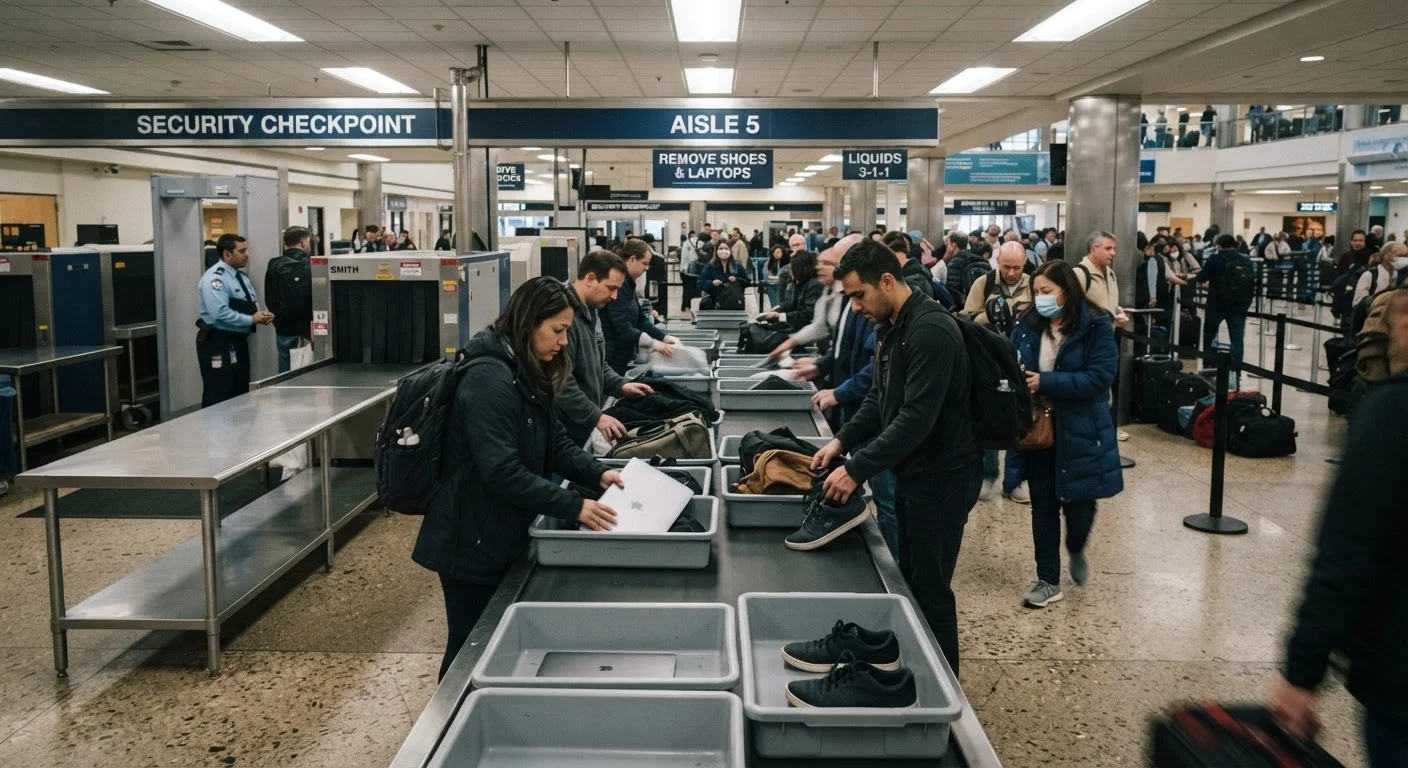
Photo credit: FaqBulletin.com | Information Made Easy
Many common TSA beliefs are flat-out wrong. Separate security fact from fiction and get through the checkpoint faster.
Key Takeaways
- TSA PreCheck does not guarantee you'll skip removing shoes every single time.
- Liquids rules apply to your carry-on, not to items in your checked luggage.
- Metal implants rarely trigger the full-body scanner alarm.
- Wearing a lot of layers or heavy jewelry is one of the biggest self-inflicted slowdowns at checkpoints.
- Arriving early cannot fully compensate for packing mistakes — preparation matters more than timing.
Why Security Lane Myths Persist
Airport security is one of those experiences Americans dread but rarely study. Most travelers rely on passed-down tips from friends, half-remembered news stories, or a single stressful trip years ago. The result? A checkpoint full of people doing things that slow the entire lane — including themselves — while believing they're doing everything right.
The Transportation Security Administration (TSA) updates its procedures regularly, yet the mythology around checkpoints stays frozen in 2002. That gap between perception and reality costs real time. Let's fix it.
Myth
You have to remove your shoes every time, no matter what.
Fact
Travelers enrolled in TSA PreCheck typically do not need to remove shoes, though officers retain discretionary authority.
The shoe-removal rule dates to a 2001 incident and applies in standard screening lanes. TSA PreCheck lanes use a different protocol that generally allows shoes to stay on. That said, TSA officers can always request additional screening at their discretion — so PreCheck isn't an absolute guarantee, but it dramatically reduces the likelihood.
Myth
The 3-1-1 liquids rule applies to everything you're traveling with.
Fact
The 3-1-1 rule only governs liquids in your carry-on bag — checked luggage follows different (and far more permissive) standards.
Many travelers unnecessarily toss full-size bottles before even reaching the checkpoint because they misunderstand the rule's scope. The 3.4-ounce (100ml) limit applies strictly to liquids, gels, aerosols, creams, and pastes carried in your hand luggage. Full-size shampoo, sunscreen, or mouthwash packed in a checked bag is generally fine. Always verify current TSA guidance for specific items, as some substances have additional restrictions regardless of bag type.
Myth
Metal implants — like joint replacements or surgical rods — will always set off the alarm.
Fact
Modern full-body imaging scanners (millimeter-wave technology) are not metal detectors and typically do not alarm for internal implants.
This is one of the most anxiety-inducing myths, particularly for older travelers. The advanced imaging technology (AIT) scanners now standard at most U.S. airports look for anomalies on the body's surface, not internal metallic objects. Walk-through metal detectors, which are still used in some lanes, can react to implants — but even then, a quick conversation with the officer and a manual pat-down resolves the situation. Carrying a medical device card can ease the process but is not required by TSA.
Myth
Packing your bag tightly makes it less likely to be flagged for extra screening.
Fact
Dense, tightly packed bags are harder for X-ray operators to read clearly and are more likely to trigger a manual search.
X-ray operators are looking for clear, interpretable images. When items are crammed together, distinct shapes become unreadable and operators must flag the bag for a physical inspection — adding several minutes to your wait. Organizing items in layers, keeping electronics easily accessible, and removing food items to a separate bin all help produce a cleaner scan image. Our carry-on packing guide covers exactly how experienced travelers organize for a clean pass.
Myth
Arriving two hours early is enough to guarantee you won't miss your flight.
Fact
Arrival time is only one variable — a preventable screening delay caused by packing errors can still make you miss a flight even with plenty of time to spare.
Extra time cushions aren't a substitute for preparation. During peak travel periods, TSA wait times can exceed 45 minutes at busy hubs even with adequate staffing. Factor in that a single flagged bag or a forgotten item in your pocket can add another 10–20 minutes. Arriving early helps, but packing correctly, wearing minimal metal, and having your ID and boarding pass ready before reaching the podium are what truly move you through efficiently.
Myth
TSA agents can access and read data from your laptop or phone during screening.
Fact
TSA's role is transportation security, not data inspection — officers are not authorized to search the contents of your devices.
TSA asks travelers to remove laptops from bags so the device can be screened as a separate item on the X-ray belt — the concern is physical concealment of prohibited items, not digital content. U.S. Customs and Border Protection (CBP) operates under a different legal authority and may inspect devices at international ports of entry, which is a separate process entirely. If you're crossing an international border, understanding CBP's authority is worth a separate look at official government resources.
Smarter Habits That Actually Speed Things Up
Once you've cleared the myths, the practical path through security becomes obvious: pack intentionally, dress simply, and know your program. If you travel frequently, enrolling in TSA PreCheck is one of the most reliable time-savers available — but even standard lanes move smoothly for prepared travelers.
For a deeper look at what truly belongs in your carry-on, see our carry-on packing guide — it's built around the logic that frequent flyers actually use, not wishful thinking.
Rules Change — Always Verify Before You Fly
TSA procedures are updated periodically, and what applied on your last trip may not apply today. Prohibited item lists, screening technology, and program eligibility can all shift. Check tsa.gov directly before each trip rather than relying on memory or secondhand advice. This is especially important after a long break from air travel.
Security rules also vary slightly by airport and are subject to change. Always verify current TSA guidelines directly at tsa.gov before your trip, especially after a long gap between flights. And if your trip involves international routing, entry requirements at your destination are a separate layer entirely — check official government sources for those. Our guide on traveling to Mexico with kids shows how many border-crossing fears are also based on outdated information.
Confidence at the checkpoint starts with knowing what's actually true. Drop the inherited myths, pack smart, and you'll spend far less mental energy before you ever reach the gate.

Author
Travel Editorial Team
Travel Editorial Team is the collective byline for our editorial team and contributor network. Articles published under this byline or an editorial pen name are researched, written, and reviewed according to our editorial standards for clarity, consistency, and independence before publication.
View all articles →