
Public, Charter, Magnet, and Private Schools: What Actually Sets Them Apart
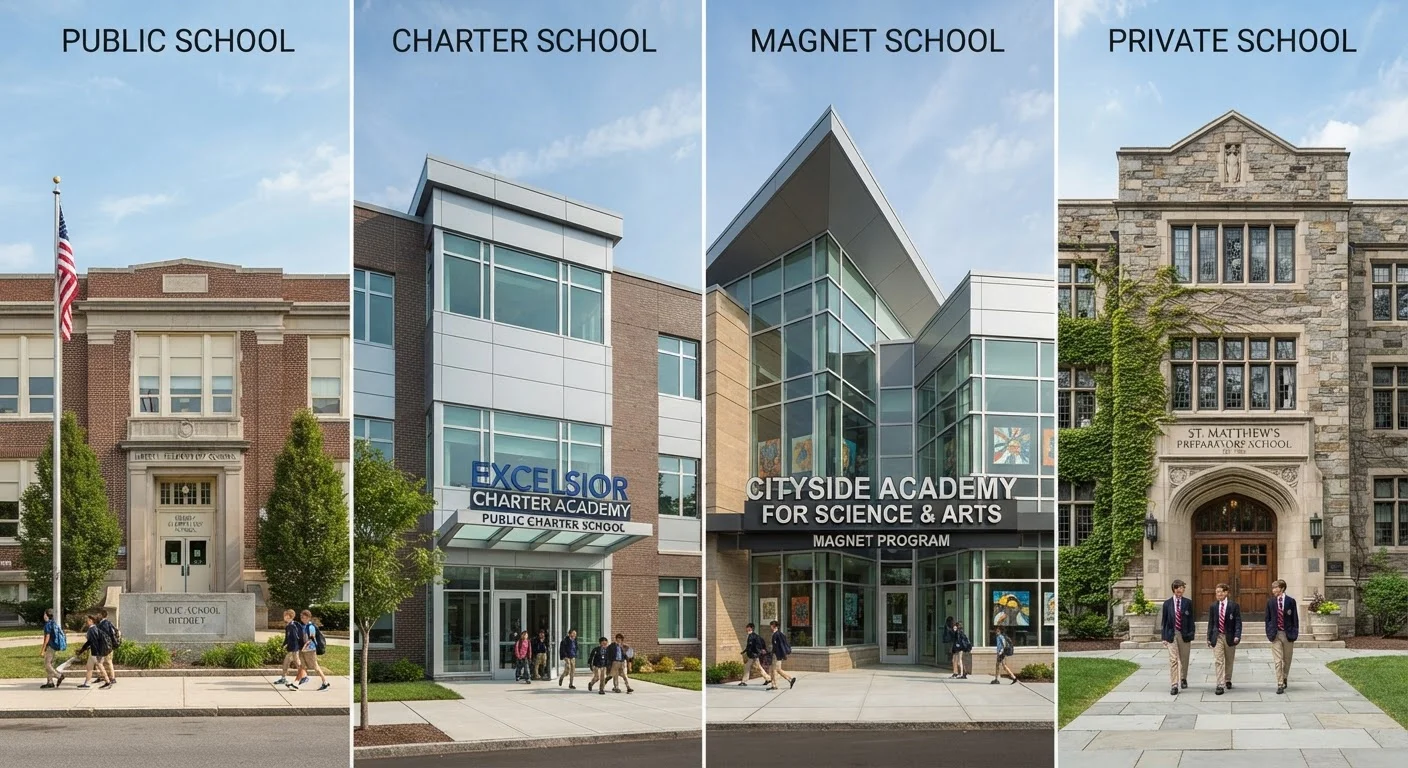
Photo credit: FaqBulletin.com | Information Made Easy
In this article
Understand the key differences between school types in the U.S. so your family can weigh the options that matter most.
Key Takeaways
- Public schools are free, government-funded, and open to all students in a district by default.
- Charter schools are publicly funded but operate under a separate charter with more curriculum flexibility.
- Magnet schools focus on a specialized theme and often draw students from across a district.
- Private schools set their own admission standards and tuition; religious schools are a common subset.
- No single school type is universally superior - the right fit depends on your child's needs and your family's priorities.
How the Four School Types Differ at a Glance
When families start researching K-12 options, the terminology can blur quickly. Public, charter, magnet, private - each label points to a different funding model, governance structure, and admissions process. Before diving deeper, see how they stack up across the criteria that matter most.
| Public | Charter | Magnet | Private | |
|---|---|---|---|---|
| Funding source | Government (tax-funded) | Government (tax-funded) | Government (tax-funded) | Tuition and donations |
| Tuition | Free | Free | Free | Varies; often significant |
| Admissions | Address-based enrollment | Open; lottery if oversubscribed | Application or lottery; competitive | School-set criteria |
| Curriculum control | State standards required | Flexible within charter terms | Theme-focused; state standards apply | School determines curriculum |
| Oversight | School district and state | Charter authorizer and state | School district | Accrediting bodies (voluntary) |
| Special education services | Federally mandated | Federally mandated | Federally mandated | Not federally required |
| Religious instruction | Not permitted | Not permitted | Not permitted | Common in parochial schools |
For a broader picture of how American schooling is structured from kindergarten through 12th grade, see The U.S. K-12 System Explained.
Traditional Public Schools: The Default Option
Traditional public schools are funded through local property taxes, state allocations, and federal contributions. They are operated by elected or appointed school boards and must follow state curriculum standards and testing requirements. Enrollment is based on where a family lives - your assigned school is determined by your home address within the district.
Because they serve all students regardless of ability, income, or background, public schools typically offer the widest range of support services, including special education programs governed by federal law (the Individuals with Disabilities Education Act, or IDEA). Class sizes and resource levels vary considerably by district wealth, which is a recognized equity challenge in U.S. education research.
If you move to a new area, enrolling in a new school district involves gathering residency documents and meeting with the local district office - a process worth understanding before moving day.
Charter Schools: Public Funding, Independent Operation
Charter schools receive public funding but are run by independent organizations - often nonprofits - under a performance contract (the "charter") with a state or local authorizer. That contract grants freedom from some district rules in exchange for measurable academic outcomes. If a charter school fails to meet its goals, its charter can be revoked.
This structure allows charters to experiment with instructional models: project-based learning, extended school days, or subject-area focus areas. They are tuition-free and open to any student, though spots are limited and many schools use a lottery system when demand exceeds capacity. Quality varies widely; research from the Stanford Center for Research on Education Outcomes (CREDO) has found that charter school performance ranges from significantly above to well below comparable public schools, depending on the state and operator.
How to Evaluate Any Charter School
Before enrolling, ask the charter school for its most recent authorizer performance report and state accountability rating. Look at how long the school has been operating - newer charters have less of a track record. Also ask what happens to enrolled students if the charter is revoked, so you have a contingency plan.
Families interested in school choice options beyond their neighborhood school should also read about open enrollment and school choice policies, which affect access to both charter and traditional public schools.
Magnet Schools: Specialized Focus Within the Public System
Magnet schools are public schools built around a specific academic theme - STEM, performing arts, language immersion, International Baccalaureate, or career and technical education, among others. They were originally developed in the 1970s as a voluntary desegregation tool, designed to attract students from different neighborhoods into a shared, theme-based environment.
Like traditional public schools, magnets are free and publicly funded. Unlike neighborhood schools, they typically draw from across an entire district or region, and admission is often competitive - through applications, auditions, testing, or lottery. Some magnet programs exist within a larger comprehensive school; others are freestanding campuses.
The appeal is specialization: a student passionate about visual arts or computer science may find a magnet environment more engaging than a general curriculum. The trade-off is often a longer commute and a more selective admissions process.
Private Schools: Independent, Tuition-Based, and Varied
Private schools operate independently of government funding and set their own admissions criteria, tuition rates, curriculum, and school culture. They are not required to follow state curriculum standards, though many seek regional accreditation voluntarily. Tuition ranges widely - from a few thousand dollars annually at some parochial schools to well over $50,000 per year at elite independent schools.
Religious or parochial schools (Catholic, Jewish day schools, evangelical Christian schools, and others) make up a large portion of the private school sector and typically integrate faith-based instruction with academics. Non-religious independent schools vary from college-preparatory programs to schools following alternative philosophies such as Montessori or Waldorf.
Financial aid is available at many private schools, particularly at well-endowed independent institutions, but it is not guaranteed and varies by school. Families should ask about aid availability early in the admissions process.
If you are also planning ahead for what comes after high school, key higher education terms every family should know is a useful next read.
Weighing the Decision for Your Family
No school type is inherently better than another. The right environment depends on several practical factors:
- Your child's learning needs: Does your child need specialized services (speech therapy, gifted programming, learning support)? Public schools have legal obligations to provide these; private schools do not.
- Geographic availability: Charter and magnet options vary significantly by state and city. Rural families often have fewer alternatives to the neighborhood public school.
- Cost tolerance: Public, charter, and magnet schools are all tuition-free. Private school tuition is a real financial commitment that should be weighed against other household priorities.
- Values and culture: Some families prioritize religious instruction, specific pedagogical approaches, or a particular community environment - factors where private schools offer the most control.
Visiting schools, reviewing state report card data (available through most state education department websites), and talking to current families are the most reliable ways to evaluate any specific school - regardless of its type. You might also consider whether homeschooling could be a viable alternative if none of the available school options feel like a strong fit.

Author
Education Editorial Team
Education Editorial Team is the collective byline for our editorial team and contributor network. Articles published under this byline or an editorial pen name are researched, written, and reviewed according to our editorial standards for clarity, consistency, and independence before publication.
View all articles →