
Homeschooling vs. Traditional School: Weighing the Real Trade-Offs
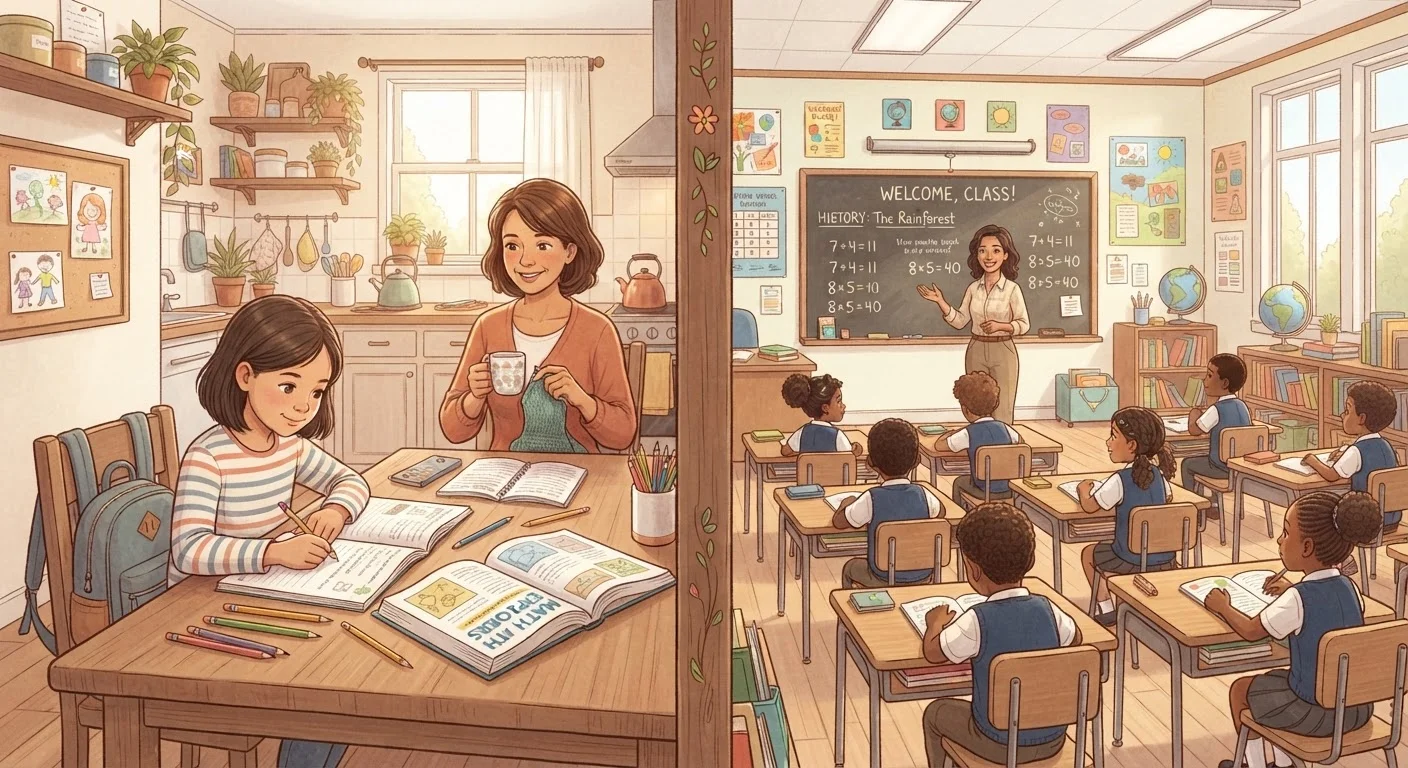
Photo credit: FaqBulletin.com | Information Made Easy
In this article
A balanced look at how homeschooling and conventional schooling compare across academics, social development, and family life.
Key Takeaways
- Homeschooling offers significant schedule flexibility and individualized pacing but places full educational responsibility on the family.
- Traditional schools provide structured social environments, credentialed teachers, and extracurricular access that are difficult to replicate at home.
- Academic outcomes vary widely in both models - family engagement and consistency matter more than the setting alone.
- State laws governing homeschooling differ significantly; families must understand their local requirements before making the switch.
- Many families blend both approaches through hybrid programs, co-ops, or part-time enrollment options.
How Each Approach Actually Works
Homeschooling means parents - or a designated instructor - take primary responsibility for their child's education outside a formal school setting. Curricula can be purchased, assembled from free resources, or structured around a philosophy such as classical education, Montessori principles, or unschooling. The family sets the schedule, chooses the materials, and determines the pace.
Traditional schooling places children in a state-accredited environment staffed by licensed educators, following a mandated curriculum aligned to grade-level standards. Students attend on a fixed calendar, are assessed on a standard timeline, and move through subjects alongside same-age peers.
A critical practical note: homeschooling is legal in all 50 states, but the rules vary substantially. Some states require annual assessments or portfolio reviews; others impose almost no oversight at all. Families considering homeschooling should consult their state's department of education or a homeschool legal association before withdrawing a child from school. See also how open enrollment and school choice policies work for families weighing alternatives within the traditional system.
Hybrid and Part-Time Options Are Growing
Many families don't choose strictly one path or the other. Hybrid homeschooling programs, microschools, and co-ops allow students to receive structured instruction a few days per week while parents fill in the rest. Some public school districts also permit homeschooled students to participate in specific classes or extracurriculars. Check with your local district to understand what's available in your area.
Side-by-Side: Key Comparison Factors
Neither option is uniformly superior - the right fit depends heavily on the child, the family's capacity, and local resources. The table below maps the most consequential factors families typically weigh.
| Criterion | Homeschooling | Traditional School |
|---|---|---|
| Schedule flexibility | High - family determines hours and calendar | Low - fixed daily and annual calendar |
| Curriculum control | Complete - parent selects all materials | Limited - state-mandated standards apply |
| Credentialed instruction | Not required in most states | Required by law for all teachers |
| Daily peer interaction | Requires deliberate planning | Built into the daily structure |
| Extracurricular access | Limited; varies by state policy | Broad - sports, arts, clubs on-site |
| Cost to family | Curriculum and material costs; lost income if a parent stops working | Public school is free; private school carries tuition |
| Regulatory oversight | Varies widely by state | Standardized state and federal oversight |
| College admissions readiness | Requires portfolio or test documentation | Transcript and GPA standard and widely accepted |
To understand how traditional school types differ from one another before making any comparison with homeschooling, see our breakdown of public, charter, magnet, and private schools.
Academic Outcomes: What the Research Actually Shows
Studies on homeschooling outcomes are mixed and methodologically difficult to compare. Research published in peer-reviewed journals has found that homeschooled students on average score higher on standardized tests - but critics note that these samples skew toward motivated, well-resourced families, which limits how broadly those results generalize.
In traditional schools, outcomes track closely with school funding, teacher quality, and family involvement. A child in a well-resourced public or private school with engaged parents may outperform a homeschooled peer whose parent lacks confidence in core subjects like mathematics or writing.
3.3M+
Homeschooled students in the U.S.
According to National Center for Education Statistics estimates, homeschooling has grown substantially over the past two decades.
~11%
Share of U.S. school-age children homeschooled
NCES data suggests homeschooling represents a meaningful and growing share of K-12 enrollment nationally.
The consistent finding across education research is that parental engagement predicts outcomes in both settings. Homeschooling makes that engagement mandatory; traditional schooling makes it optional - which is both a feature and a risk, depending on the family.
Social Development and Real-World Readiness
The most common concern raised about homeschooling is socialization. It's a legitimate question, though the framing is often too narrow. Homeschooled children do typically have fewer automatic peer interactions than their traditionally schooled counterparts - but many families address this deliberately through co-ops, community sports leagues, church groups, and dual enrollment at local schools.
Traditional schools offer something harder to engineer independently: daily, unscripted interaction with diverse peers across many situations - the cafeteria, group projects, conflict resolution with classmates, navigating different teacher personalities. These repeated low-stakes social moments accumulate into real interpersonal skills over time.
Families who homeschool successfully tend to be intentional and proactive about creating structured social opportunities. Families who rely on school alone for socialization, without reinforcing those skills at home, may also find gaps. Neither environment is a shortcut.
For families considering non-traditional academic calendars in either setting, our analysis of year-round schooling trade-offs explores how schedule structure affects student and family life.

Author
Education Editorial Team
Education Editorial Team is the collective byline for our editorial team and contributor network. Articles published under this byline or an editorial pen name are researched, written, and reviewed according to our editorial standards for clarity, consistency, and independence before publication.
View all articles →