
The Debt Avalanche vs. Debt Snowball: Which Payoff Strategy Fits Your Life?
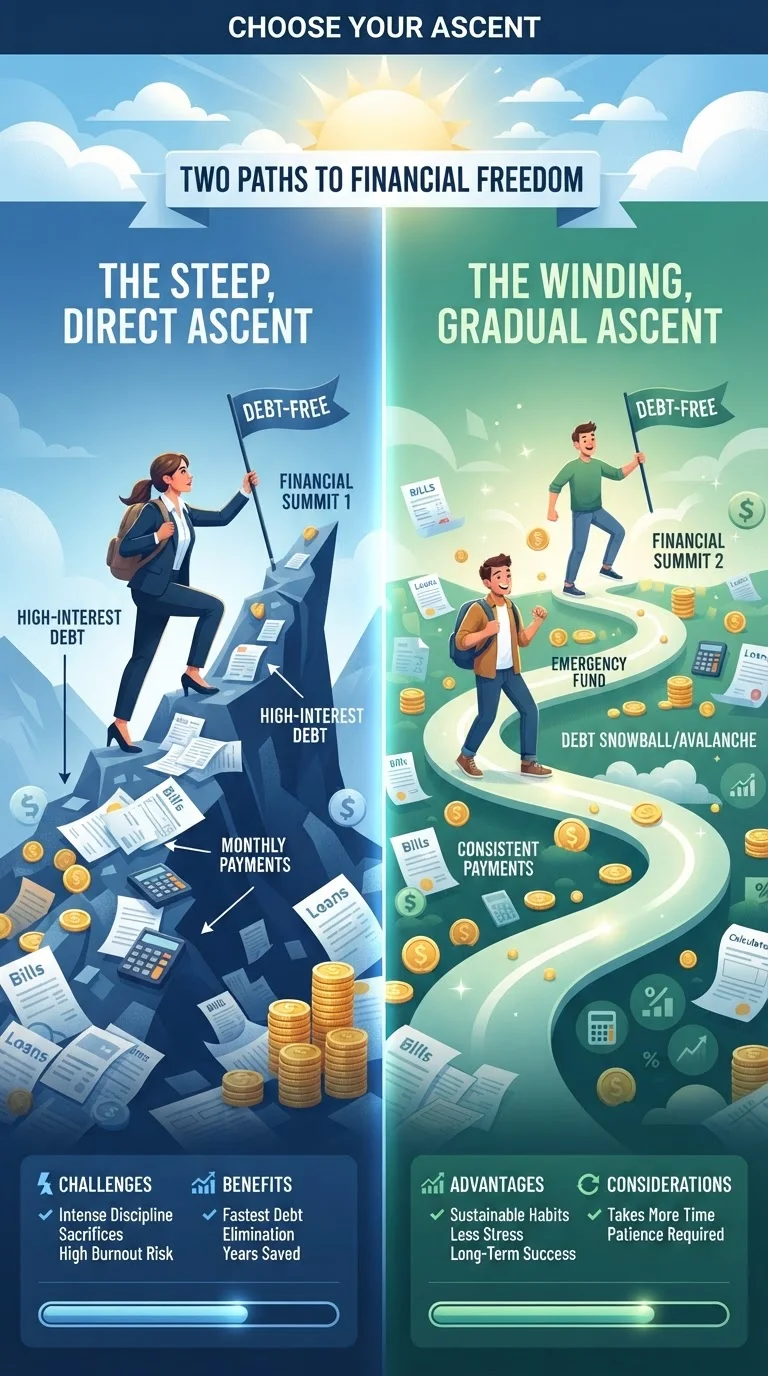
Photo credit: FaqBulletin.com | Information Made Easy
In this article
Understand how the debt avalanche and debt snowball methods work, and which approach makes sense for your financial situation.
Key Takeaways
- The debt avalanche targets your highest-interest debt first, reducing total interest paid over time.
- The debt snowball eliminates smallest balances first, delivering quick wins that reinforce motivation.
- Research suggests behavior — not math — is often the biggest obstacle to paying off debt successfully.
- Both methods require paying minimums on all debts and directing extra cash to one target account.
- The best strategy is the one you'll actually stick with through to completion.
How Each Method Actually Works
Both the debt avalanche and debt snowball follow the same basic structure: pay the minimum on every debt, then throw any extra money at one specific target. The difference is how you choose that target.
Debt Avalanche: You rank your debts by interest rate, highest to lowest. All extra payments go toward the highest-rate balance until it's gone, then you roll that payment into the next one. Because high-interest debt compounds fastest, eliminating it first means you pay less over the life of your repayment plan. If you're carrying a credit card at 24% APR alongside a personal loan at 10%, the avalanche sends your extra dollars to that card first — every time.
Debt Snowball: You rank debts by balance, smallest to largest, ignoring interest rates entirely. Extra payments attack the smallest balance until it's wiped out. Then the freed-up payment amount "snowballs" into the next smallest. The method was popularized by personal finance educator Dave Ramsey and is explicitly designed around the psychology of habit formation — small wins compound into sustained effort.
Before choosing, it helps to understand how minimum payments extend your repayment timeline, since both strategies depend on paying more than the minimum.
| Criterion | Debt Avalanche | Debt Snowball |
|---|---|---|
| Payoff order | Highest interest rate first | Smallest balance first |
| Total interest paid | Lower (mathematically optimal) | Higher (rate ignored) |
| Time to first payoff | Potentially longer | Faster early wins |
| Motivation model | Rational, math-driven | Behavioral, momentum-driven |
| Best debt scenario | High-rate balances dominate | Many small, scattered balances |
| Risk of abandonment | Higher without quick wins | Lower due to early success |
The Real Cost Difference — And Why It May Not Be Decisive
On paper, the avalanche wins every time. By eliminating high-interest balances first, you reduce the amount of interest accumulating on your remaining debt, which means more of every future payment goes toward actual principal. Depending on your debt mix, this can translate into hundreds or even thousands of dollars saved compared to the snowball approach.
~$1,000+
Potential interest savings with avalanche vs. snowball
The exact amount varies widely by debt mix, but financial planning analyses consistently show the avalanche method saves more in interest on typical household debt portfolios.
3 in 4
Americans carrying some form of non-mortgage debt
Federal Reserve consumer finance surveys have consistently found the majority of U.S. households carry credit card, auto, student loan, or personal loan balances.
Higher completion
Snowball adherence vs. other methods
Research published in the Journal of Marketing Research found consumers are more motivated by progress toward goal completion than by the size of the remaining task.
But here's the honest reality: the avalanche's mathematical advantage disappears entirely if you quit. Research in behavioral economics — including work published in the Journal of Marketing Research — has found that progress toward a goal, not the size of the goal, is the stronger predictor of sustained effort. Paying off a $400 medical bill may feel trivial compared to chipping away at a $9,000 credit card, but the dopamine from completing it is real and measurable.
Neither method is universally superior. What matters is understanding your own track record with financial commitments. If you've abandoned debt payoff plans before, the snowball's built-in motivation system may be worth more than the avalanche's interest savings. If you're the type who runs spreadsheets on weekends and finds satisfaction in compound math working in your favor, the avalanche is likely a better fit.
For households navigating the tension between debt and savings goals simultaneously, see our article on saving while carrying debt for a fuller picture of how to balance both priorities.
Putting a Strategy Into Practice
Whichever method you choose, execution follows the same discipline: list all debts, note balances and interest rates, confirm minimum payments, and identify how much extra you can direct to your target debt each month. Even an additional $50 per month accelerates payoff significantly over time.
A few practical notes worth keeping in mind:
- Don't close accounts immediately after payoff. Keeping older accounts open (with zero balances) generally benefits your credit utilization ratio.
- Maintain a small emergency buffer. Experts commonly recommend at least one month's essential expenses in a liquid account before aggressive debt payoff — otherwise an unexpected bill can derail the entire plan.
- Automate minimum payments. Late fees and penalty rates can wipe out your progress. Set minimums to auto-pay and direct discretionary effort toward your target debt.
- Revisit the strategy if your situation changes. A job change, new debt, or a windfall (tax refund, bonus) may warrant switching tactics.
There are also hybrid approaches — for example, starting with the snowball to build momentum, then shifting to the avalanche once you've cleared two or three small balances. The key is having a consistent framework, not a perfect one.
For a broader look at staying financially resilient while paying down debt, the principles for paying off debt without derailing your financial life covers how to protect your credit and avoid burnout along the way. You might also find the budgeting basics hub useful for building the monthly structure that makes either strategy possible.
This article is for general informational and educational purposes only and does not constitute personalized financial advice. Consult a qualified financial professional for guidance specific to your situation.

Author
Personal Finance Editorial Team
Personal Finance Editorial Team is the collective byline for our editorial team and contributor network. Articles published under this byline or an editorial pen name are researched, written, and reviewed according to our editorial standards for clarity, consistency, and independence before publication.
View all articles →