
Insulation Types Side by Side: Batts, Blown-In, Spray Foam, and Rigid Board
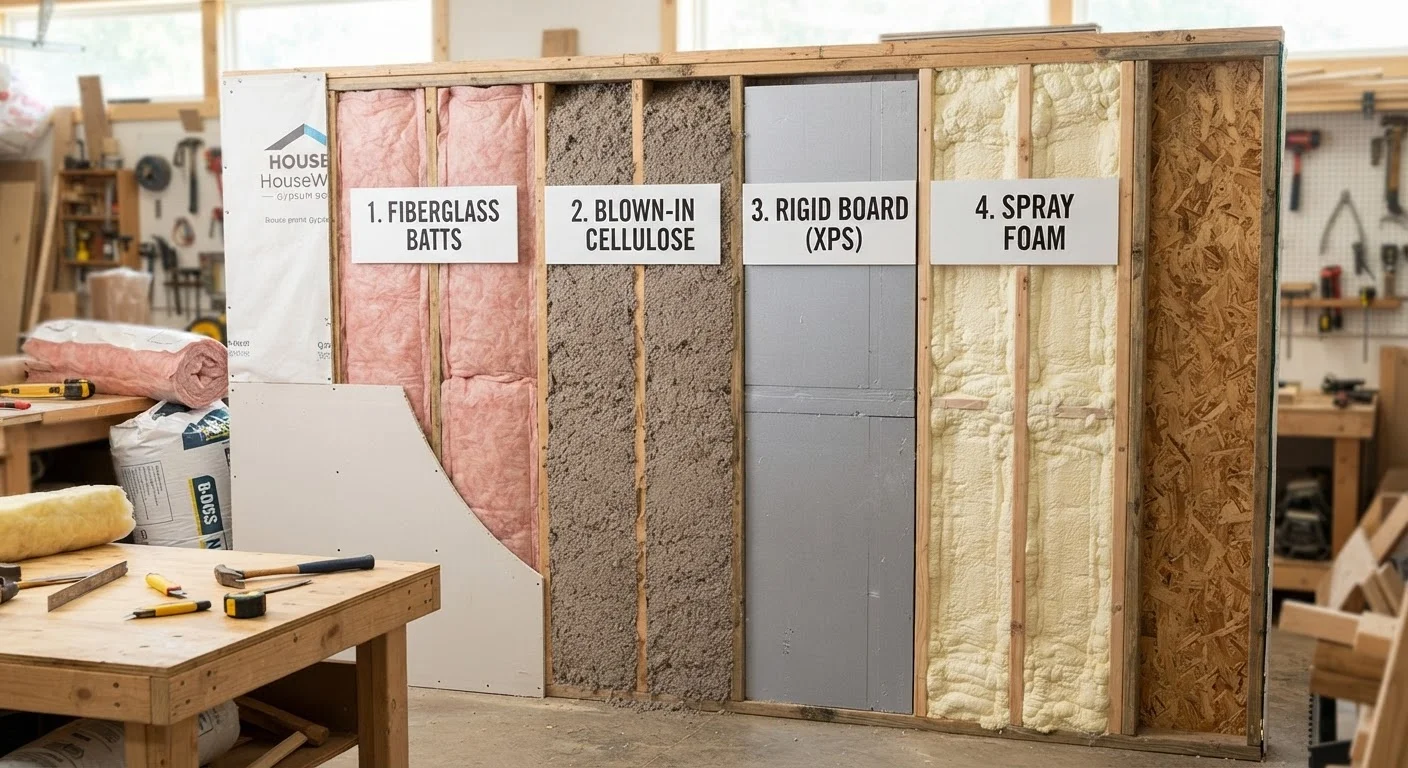
Photo credit: FaqBulletin.com | Information Made Easy
In this article
Each insulation material has different R-values, installation requirements, and ideal applications. Compare them before committing to a project.
Key Takeaways
- R-value measures thermal resistance; higher values mean better insulation performance per inch.
- Spray foam offers the highest air-sealing capability but requires professional installation for closed-cell applications.
- Batts are the most DIY-friendly option, while blown-in excels in irregular or hard-to-reach spaces.
- Rigid board insulation is ideal for exterior walls, under slabs, and areas with limited cavity depth.
- Choosing the wrong insulation type for a given application can reduce energy efficiency and increase costs.
Why Insulation Type Matters Before You Buy
Insulation is not a one-size-fits-all purchase. The wrong material in the wrong location can underperform for years — costing more in energy bills than the installation saved upfront. Four types dominate residential projects in the U.S.: batts, blown-in, spray foam, and rigid board. Each has distinct R-values per inch, installation demands, and ideal use cases.
R-value is the standard measure of thermal resistance. A higher R-value means more resistance to heat flow. Local building codes set minimum R-values by climate zone — check with your local building department before specifying any insulation project. Always verify whether your project requires a permit or inspection, particularly for spray foam in conditioned spaces.
| Batts | Blown-In | Spray Foam (Closed-Cell) | Rigid Board (XPS) | |
|---|---|---|---|---|
| R-value per inch | R-2.9 to R-3.8 | R-2.2 to R-3.8 | R-6.0 to R-6.5 | ~R-5.0 |
| Air sealing ability | Low — needs barrier | Low to moderate | Excellent | Moderate with taped seams |
| DIY friendliness | High | Moderate | Low (professional advised) | Moderate to high |
| Typical cost range | Lower | Low to moderate | Higher | Moderate |
| Best application | Open stud/joist bays | Attics, retrofit walls | Crawl spaces, rim joists | Exterior sheathing, slabs |
| Moisture resistance | Low | Low to moderate | High (closed-cell) | High (XPS/EPS) |
| Permit often required | Sometimes | Sometimes | Often | Sometimes |
Batts: The DIY Standard
Batt insulation — available in fiberglass or mineral wool — comes in pre-cut panels sized to fit standard 16-inch and 24-inch stud spacing. Fiberglass batts typically deliver R-2.9 to R-3.8 per inch; mineral wool (also called rock wool or stone wool) runs R-3.0 to R-3.3 per inch and adds fire resistance and better sound dampening.
Batts are the most accessible option for homeowners comfortable with basic tools. Installation requires cutting around obstacles, fitting snugly without compression (compression reduces R-value), and leaving no gaps at edges. They work best in open, unobstructed stud or joist bays — exterior walls, attic floors, and floor framing over unconditioned spaces are all suitable applications.
The main limitation: batts don't air-seal. They should be paired with a separate air barrier — such as house wrap or drywall — to prevent convective heat loss through gaps.
Blown-In: Best for Irregular Spaces
Blown-in insulation — typically cellulose (recycled paper fiber) or loose-fill fiberglass — is installed using a blowing machine. Cellulose runs approximately R-3.2 to R-3.8 per inch; loose-fill fiberglass is similar at R-2.2 to R-2.7 per inch.
The key advantage is adaptability. Blown-in material conforms around joists, pipes, and irregular framing without gaps. Attic floors are the classic application — a professional or experienced DIYer can bring an attic to code-required depth efficiently. Dense-pack blown-in can also retrofit insulation into existing finished walls through small drilled holes, avoiding drywall tear-out.
Renting a Blower Machine
Many home improvement retailers offer blower machine rentals when you purchase a minimum quantity of loose-fill bags. This can make attic blown-in a practical weekend project for a confident DIYer. Always wear respiratory protection and eye protection, and ensure the attic space is properly ventilated before beginning work.
Settling is a legitimate consideration with cellulose: it can compact over time, slightly reducing effective R-value. Installers typically account for this by installing at a higher initial depth than the finished target.
Spray Foam: Highest Air Sealing Performance
Spray polyurethane foam (SPF) comes in two forms. Open-cell foam is lighter and softer, delivering around R-3.5 to R-3.7 per inch — useful for interior wall cavities and sound reduction. Closed-cell foam is denser, with R-6.0 to R-6.5 per inch, and acts as both insulation and a vapor retarder.
Spray foam's defining advantage is air sealing. When properly applied, it fills every crack and penetration, which makes it particularly effective for rim joists, crawl spaces, and irregular gaps. Closed-cell foam also resists moisture — a meaningful benefit in below-grade or high-humidity environments.
The trade-offs are cost and installation complexity. Closed-cell spray foam is significantly more expensive per square foot than batts or blown-in. Professional installation is strongly recommended for most applications: improper mixing ratios or off-ratio foam can emit odors and perform poorly. Many building codes also require a thermal or ignition barrier (typically drywall) over exposed spray foam in living areas.
Rigid Board: The Exterior and Below-Grade Specialist
Rigid foam board comes in three main types: expanded polystyrene (EPS) at roughly R-3.6 to R-4.2 per inch, extruded polystyrene (XPS) at approximately R-5.0 per inch, and polyisocyanurate (polyiso) at around R-5.6 to R-6.5 per inch under typical conditions.
Rigid board excels where cavity depth is limited or where continuous insulation is needed to minimize thermal bridging through framing. Common applications include exterior wall sheathing, foundation walls, under concrete slabs, and insulating basement walls from the interior. XPS and EPS perform reliably in below-grade and damp environments; polyiso is best suited to above-grade applications where temperatures stay moderate, as its effective R-value can decrease in very cold conditions.
Rigid board is cuttable with a utility knife or circular saw and manageable for experienced DIYers, though large exterior re-cladding projects often benefit from professional installation to meet code requirements for weather barriers and fastening.

Author
Home & Garden Editorial Team
Home & Garden Editorial Team is the collective byline for our editorial team and contributor network. Articles published under this byline or an editorial pen name are researched, written, and reviewed according to our editorial standards for clarity, consistency, and independence before publication.
View all articles →