
Engineered Hardwood vs. Solid Hardwood Flooring
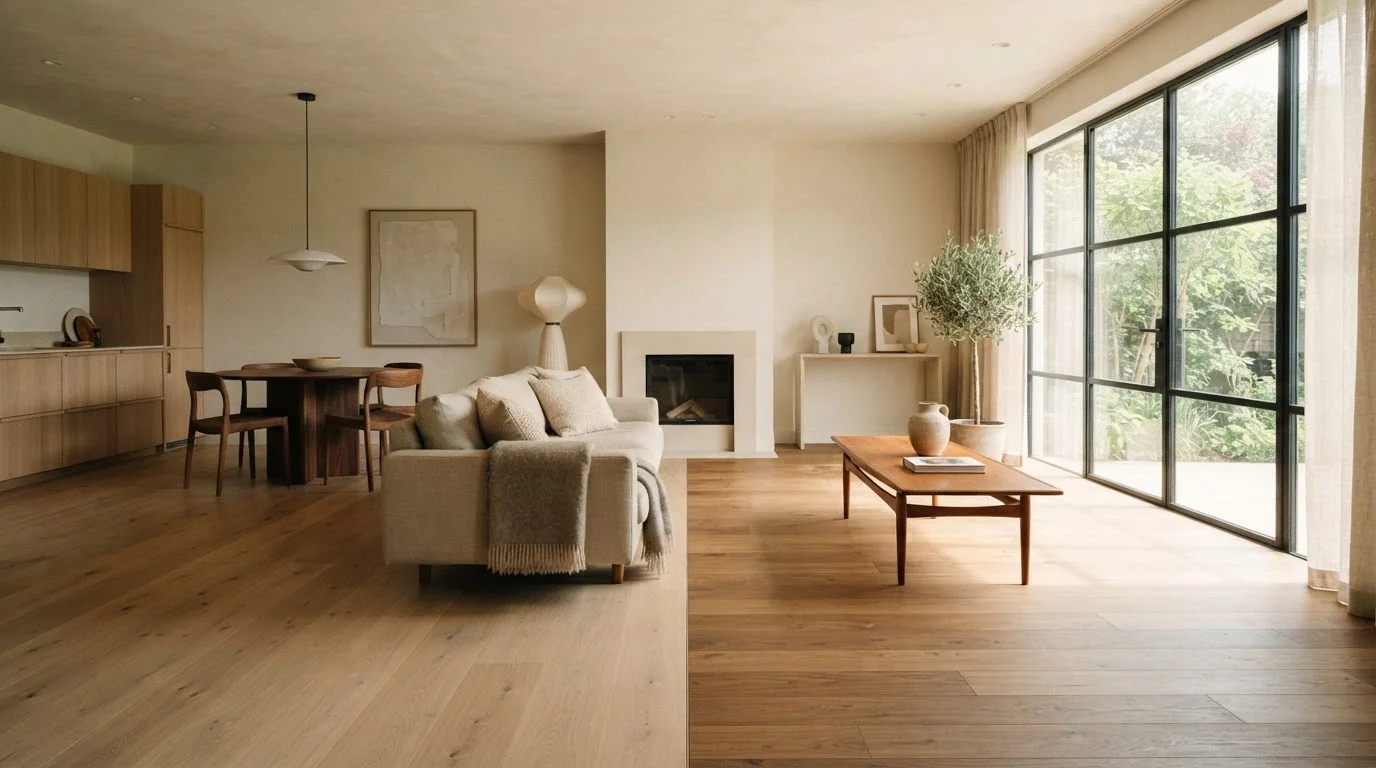
Photo credit: FaqBulletin.com | Information Made Easy
In this article
Both look alike on the surface, but they behave very differently across climates, subfloors, and time. Here's what sets them apart.
Key Takeaways
- Engineered hardwood handles moisture and temperature swings better than solid hardwood.
- Solid hardwood can be sanded and refinished more times over its lifespan, potentially lasting 80–100 years.
- Engineered hardwood is suitable for installation over concrete or radiant heat systems; solid hardwood generally is not.
- Both types feature a real wood wear layer on top, so surface appearance is virtually identical.
- Installation method, subfloor type, and local climate should drive your flooring choice more than aesthetics alone.
What's Actually Inside Each Plank
The most important difference between these two flooring types isn't visible from the top — it's what lies beneath the surface.
Solid hardwood is exactly what the name implies: a single piece of wood milled from one species, typically ¾ inch thick. Because it's uniform throughout, it can be sanded down and refinished repeatedly — usually four to six times across its life. That's a meaningful advantage in rooms that see heavy traffic or cosmetic wear.
Engineered hardwood is a layered composite. A genuine hardwood veneer — the same species you'd find in solid planks — sits on top of a core built from cross-layered plywood or high-density fiberboard (HDF). These alternating grain directions counteract the wood's natural tendency to expand and contract with moisture changes. The result is a plank that looks identical on the surface but behaves differently under stress.
| Criterion | Engineered Hardwood | Solid Hardwood |
|---|---|---|
| Construction | Hardwood veneer over plywood/HDF core | Single solid wood plank |
| Typical thickness | 3/8" – 9/16" | 3/4" |
| Moisture resistance | Good — dimensionally stable | Poor — expands and contracts |
| Suitable locations | Below, on, or above grade | Above grade only |
| Radiant heat compatible | Yes (most products) | Generally not recommended |
| Refinishing potential | 1–3 times (veneer dependent) | 4–6 times over lifetime |
| DIY installation ease | Easier (floating option available) | More difficult (nail-down required) |
| Typical lifespan | 25–30 years | 80–100 years with refinishing |
Where Each Type Works — and Where It Doesn't
Subfloor type and room location are the two factors that most reliably separate the right choice from the wrong one.
Solid hardwood requires a wood subfloor and must be installed above grade (meaning above ground level). It is not suitable for basements or over concrete without extensive moisture mitigation. It's also sensitive to humidity: in climates where indoor humidity fluctuates more than about 15–20 percentage points seasonally, solid planks can develop gaps in winter and buckle in summer.
Engineered hardwood can go below grade, above grade, or directly over concrete with proper moisture testing. Most engineered products are also approved for use over radiant heating systems — a scenario where solid hardwood is generally not recommended.
Check Moisture Levels Before Any Installation
Regardless of which flooring type you choose, moisture testing your subfloor is a non-negotiable first step. Concrete slabs should be tested with a calcium chloride test or an in-situ relative humidity probe per ASTM standards. Even engineered hardwood has moisture exposure limits — exceeding the manufacturer's threshold can void the warranty and cause premature failure.
One practical note on refinishing engineered floors: the veneer layer thickness varies widely by product, typically ranging from 1 mm to 6 mm. Thinner veneers may allow only one light sanding, while thicker ones can be refinished two to three times. Always confirm the wear-layer thickness before purchasing.
Installation Methods and Long-Term Maintenance
Both flooring types support nail-down installation over wood subfloors. Beyond that, their options diverge.
Engineered hardwood adds two more methods to the mix: glue-down (directly adhered to concrete or plywood) and floating (planks click together and rest freely over an underlayment without being fastened to the subfloor). Floating installation is the most DIY-accessible approach and doesn't permanently bond the floor, making future removal easier.
Solid hardwood is typically nail- or staple-down only, which requires a pneumatic flooring nailer and more subfloor preparation. It is a less forgiving installation for beginners.
For ongoing care, both types respond well to dry mopping, occasional damp mopping with a wood-appropriate cleaner, and consistent indoor humidity management (generally 35–55% relative humidity is the recommended range for wood floors). Protecting solid hardwood from moisture exposure is especially critical — even spills left too long can cause cupping or staining that penetrates deeper than a surface refinish can reach.
When damage does occur over time, solid hardwood's extra thickness means individual boards can often be spot-sanded and blended back in. Engineered boards with thin veneers may need full replacement if deeply scratched or gouged.

Author
Home & Garden Editorial Team
Home & Garden Editorial Team is the collective byline for our editorial team and contributor network. Articles published under this byline or an editorial pen name are researched, written, and reviewed according to our editorial standards for clarity, consistency, and independence before publication.
View all articles →