
Community College vs. Four-Year University: What the Choice Actually Costs You
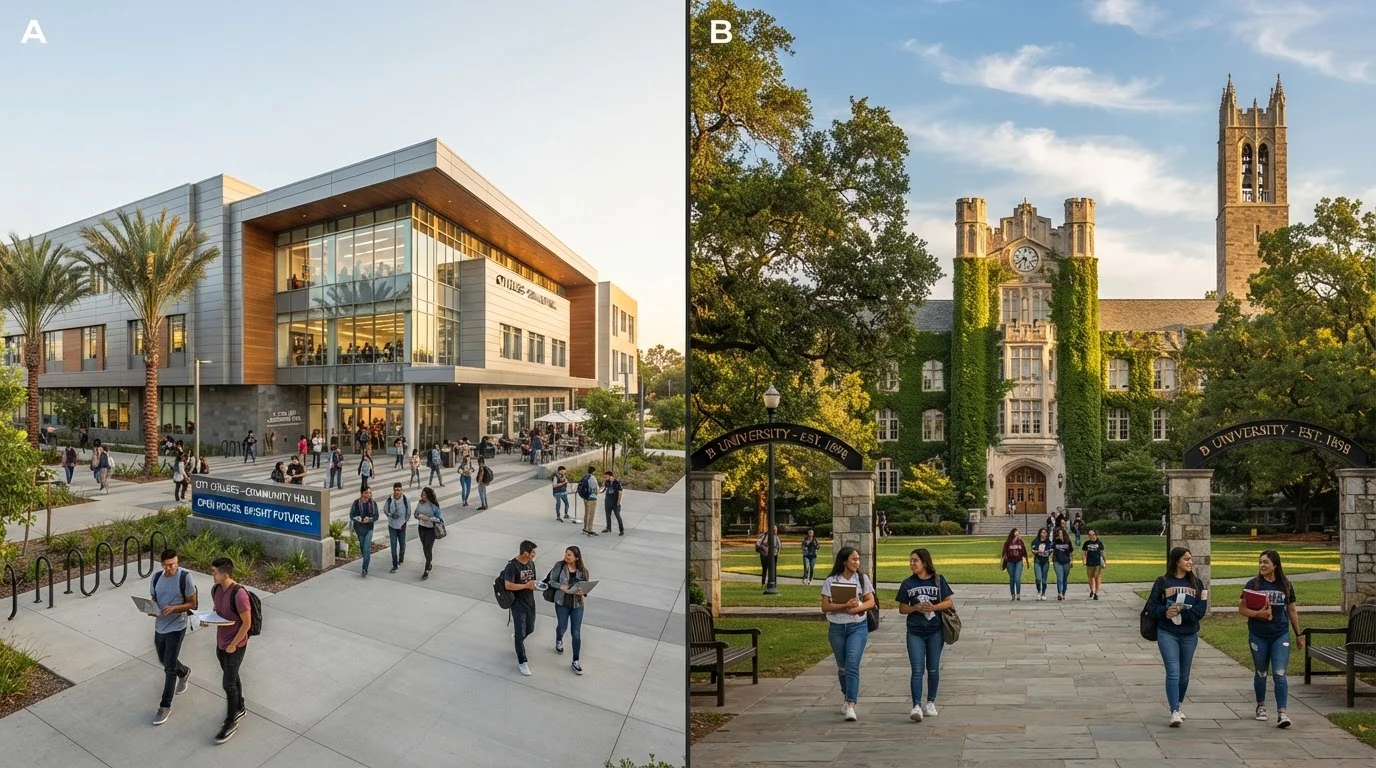
Photo credit: FaqBulletin.com | Information Made Easy
In this article
Beyond tuition sticker prices, here's what the two-year vs. four-year decision means for debt, time, and career outcomes.
Key Takeaways
- Community college tuition is typically 3-4 times cheaper per credit hour than public four-year universities.
- The 2+2 transfer pathway can yield a bachelor's degree at significantly lower total cost if credits transfer successfully.
- Four-year graduates earn more on average, but community college credentials offer strong returns in specific career fields.
- Opportunity cost - time spent in school vs. working - matters as much as tuition when comparing total cost.
- Credit transfer policies vary widely; articulation agreements are the key factor to investigate before enrolling.
- Neither path is universally superior - the right choice depends on career goals, finances, and personal circumstances.
What You're Actually Comparing
The headline numbers are familiar: community colleges cost less. But the real comparison is more layered. Cost, time-to-degree, career outcomes, and personal fit all interact in ways the sticker price alone can't capture.
According to the College Board, average annual in-district tuition and fees at public two-year colleges is roughly $3,900, compared to approximately $11,260 at public four-year institutions for in-state students. That's a meaningful gap - but it's only part of the picture. Room and board, opportunity cost, and how long you actually spend enrolled all shape what each path ends up costing in practice.
Before comparing options, it also helps to understand what you're working toward. See our framework for choosing a college major - knowing your direction sharpens every cost-benefit calculation below.
| Criterion | Community College | Four-Year University |
|---|---|---|
| Avg. Annual Tuition (Public) | ~$3,900 (in-district) | ~$11,260 (in-state) |
| Time to Credential | 2 years (associate degree) | 4 years (bachelor's degree) |
| Path to Bachelor's Degree | Transfer (2+2 pathway) | Direct enrollment |
| Typical Class Size | Smaller, more accessible | Varies; large lectures common |
| Schedule Flexibility | High (evening/weekend options) | Lower (traditional semester) |
| Campus/Residential Life | Limited or none | Full residential experience |
| Avg. Student Debt at Graduation | Lower | Higher |
| Graduate/Professional School Access | Possible, with transfer degree | More direct pipeline |
The Real Cost Equation: Tuition, Debt, and Time
Total cost of attendance isn't just tuition. It includes fees, books, transportation, and living expenses - categories where the gap between school types can narrow or widen depending on whether you live at home, on campus, or independently.
For students pursuing the 2+2 pathway - two years at a community college, then two years at a university - the potential savings are substantial, provided credits transfer. The National Student Clearinghouse Research Center has found that a significant share of community college transfer students lose credits when moving to a four-year institution, inflating both cost and time. Our article on how college credits transfer explains what articulation agreements are and exactly what to ask before you enroll.
Debt matters too. Students who begin at community college and transfer carry lower average loan balances than those who spend all four years at a university, according to data from the National Center for Education Statistics - but only when the transfer is planned and credits are accepted.
~$3,900
Avg. community college annual tuition
According to the College Board's Trends in College Pricing report, average in-district tuition and fees at public two-year colleges is significantly below four-year institutions.
~$1M
Lifetime earnings gap, bachelor's vs. associate
The Georgetown Center on Education and the Workforce estimates this median lifetime earnings difference, though it varies substantially by field.
43%
Community college students who transfer to 4-year schools
According to the National Student Clearinghouse Research Center, a substantial share of community college students intend to transfer, though completion rates vary.
Career Outcomes: Does the Starting Point Matter?
Earnings data consistently shows bachelor's degree holders out-earn those with associate degrees or some college over a lifetime. The Georgetown Center on Education and the Workforce estimates the median lifetime earnings gap between a bachelor's and an associate degree at around $1 million. However, that figure is heavily influenced by field of study.
In healthcare technology, skilled trades, and business administration, community college credentials - particularly Associate of Applied Science degrees and industry certifications - deliver strong, fast returns. A dental hygienist or a network technician with a two-year credential can earn a competitive salary without the debt load of a four-year degree.
Employer recruiting pipelines and graduate school prerequisites, on the other hand, often favor four-year degrees. If your goal is law school, medicine, or a management training program at a large corporation, the four-year path typically provides better access to the specific credentials and networks those tracks require.
It's also worth noting what a university's acceptance letter doesn't tell you. Net price, job placement rates, and retention data are rarely in that initial offer packet - our guide on what a college acceptance letter doesn't tell you covers what to look up before committing.
Who Each Path Actually Serves Best
Community college excels for students who need schedule flexibility - working adults, caregivers, or those still deciding on a career path. Classes often run evenings and weekends, and the lower financial stakes make it easier to pause and restart. For adult learners specifically, the comparison between local community colleges and online platforms is worth examining: see our community college vs. online platform comparison for a detailed breakdown.
Four-year universities serve students well when the career target is degree-specific, when the networking and residential experience add genuine value, or when the student is ready to commit four years of full-time focus. Certain financial aid packages - merit scholarships and grants - can make four-year institutions more affordable than their sticker prices suggest, which is why comparing net price, not published tuition, is essential.
High school students who want to get a head start should also consider how AP and dual enrollment credits can reduce costs at either institution type. Our AP vs. dual enrollment comparison walks through how each option works and what transfers reliably.
Neither path is a consolation prize. The decision that costs you least - financially, professionally, and personally - is the one that aligns with where you're actually going.

Author
Education Editorial Team
Education Editorial Team is the collective byline for our editorial team and contributor network. Articles published under this byline or an editorial pen name are researched, written, and reviewed according to our editorial standards for clarity, consistency, and independence before publication.
View all articles →